Nutrition · October 27, 2026 · 13 min read
How many calories in a banana? By size, ripeness and form
Banana calories by size, per 100 g, with or without the peel, green or very ripe, dried, as chips or as plantain, plus your favourite snacks and what a banana is worth before exercise or when you want to lose weight.
Banana calories: the numbers by size and form
Published on October 27, 2026 · By the Ember team
In short
A medium banana (118 g without the peel) has just over 100 kcal: France’s Ciqual food table lists 87.6 kcal per 100 g of raw banana. A very small one has around 70 kcal, a very large one around 135 kcal.
Weighed with its peel, a banana has only about 58 kcal per 100 g, because the peel makes up roughly a third of the weight.
Green or spotty, a banana has about the same calories. What changes is the type of carbohydrate: mostly starch when it is green, mostly sugars when it is ripe, with a higher glycaemic index.
Dried, its calories become concentrated (365 kcal per 100 g); fried banana chips reach about 500 kcal per 100 g, or about 150 kcal for a 30 g handful.
How many calories in a banana? It depends on the size
A banana is the fruit you grab on your way out in the morning, throw into a gym bag or mash into porridge, without ever weighing it. Yet between a very small banana and a very large one, the gap is more than 60 kcal. According to Ciqual, the French national food composition table run by the food safety agency ANSES, 100 g of raw banana without the peel provides 87.6 kcal, 19.7 g of carbohydrate including 15.6 g of sugars, 2.7 g of fibre, just over 1 g of protein and almost no fat.
The real question is how much your banana weighs once peeled. The USDA, the US Department of Agriculture, which publishes the FoodData Central database, gives reference weights by length: 81 g of flesh for an extra small banana, 118 g for a medium one and 152 g for an extra large one. With those weights, a medium banana provides about 103 kcal. Using its own analyses (89 kcal per 100 g), the USDA gets 105 kcal for the same banana.
Norway’s Matvaretabellen tells the same story: 88 kcal per 100 g and 120 g for one banana, which makes 106 kcal. Per piece of fruit, the gaps between the big food tables add up to two or three calories, nothing that changes your day.
| Size (length) | Weight without peel | Weight with peel | Calories | Carbs | Of which sugars |
|---|---|---|---|---|---|
| Extra small (under 15 cm) | 81 g | ≈ 125 g | ≈ 71 kcal | 16 g | 12.6 g |
| Small (15 to 17.5 cm) | 101 g | ≈ 155 g | ≈ 88 kcal | 19.9 g | 15.8 g |
| Medium (18 to 20 cm) | 118 g | ≈ 180 g | ≈ 103 kcal | 23.2 g | 18.4 g |
| Large (20 to 22.5 cm) | 136 g | ≈ 205 g | ≈ 119 kcal | 26.8 g | 21.2 g |
| Extra large (23 cm and over) | 152 g | ≈ 230 g | ≈ 133 kcal | 29.9 g | 23.7 g |
Ember’s calculation from the Ciqual table (raw banana: 87.6 kcal, 19.7 g carbohydrate and 15.6 g sugars per 100 g) and the USDA peeled weights for each size (lengths converted from inches). Weight with peel: 66% edible part, the value used by Matvaretabellen.
Keep one simple rule in mind: count 70, 90, 100, 120 or 135 kcal for an extra small, small, medium, large or extra large banana. If you are unsure, weigh one peeled banana just once: after that, you will be able to place the ones you usually buy at a glance.
Per 100 g: calories, sugars, fibre and potassium
In a banana, almost all the calories come from carbohydrate. A ripe banana mostly contains sugars (glucose, fructose and sucrose) plus some leftover starch, around 4 g per 100 g according to the European tables. Water, which makes up three quarters of the weight, and fibre, about 2 to 3 g per 100 g, explain why a banana stays moderate in calories despite its reputation as a sugary fruit.
The table compares the three big food tables. One difference may surprise you: the USDA shows 22.8 g of carbohydrate, against 19.7 g for Ciqual and Matvaretabellen. It is not a different banana, it is a different method: in the United States, carbohydrate is calculated “by difference” and includes fibre, while European tables count fibre separately.
Weight for weight, a banana is denser than many fruits: 87.6 kcal per 100 g, against 54 kcal for a raw apple with its peel, again according to Ciqual. Our guide on apple calories goes through that comparison in detail.
| Per 100 g of raw banana | Ciqual (France) | USDA (United States) | Matvaretabellen (Norway) |
|---|---|---|---|
| Energy | 87.6 kcal | 89 kcal | 88 kcal |
| Carbohydrate | 19.7 g | 22.8 g (fibre included) | 19.7 g |
| Of which sugars | 15.6 g | 12.2 g | 15.4 g |
| Of which starch | 3.8 g | 5.4 g | 4.3 g |
| Fibre | 2.7 g | 2.6 g | 2 g |
| Protein | 1.1 g | 1.1 g | 1.1 g |
| Fat | less than 0.5 g | 0.3 g | 0.2 g |
| Potassium | 320 mg | 358 mg | 348 mg |
Raw flesh without the peel: Ciqual 2025 (ANSES), USDA FoodData Central (SR Legacy) and Matvaretabellen. The differences come from varieties, the ripeness of the samples and lab methods.
Bananas are often praised for their potassium. A medium banana provides about 380 mg, close to 11% of the adequate intake set by EFSA, the European Food Safety Authority, for adults (3,500 mg a day): a useful top-up rather than a record, since plantain contains more (499 mg per 100 g according to Ciqual).
Green or very ripe banana: same calories, different carbs
Leave a green banana in the fruit bowl for a few days and it changes: sweeter, softer, then flecked with brown. It is not just your imagination. In an under-ripe banana, starch makes up 80 to 90% of the carbohydrate; as the fruit ripens, it turns into sugars. A study published in 1986 in the American Journal of Clinical Nutrition measured the scale of the change: starch fell from 37% of the dry weight in the least ripe bananas to 3% in the ripest.
This change does not create calories, but it changes what happens to them. In the same study, carried out in people with an ileostomy (which makes it possible to collect what leaves the small intestine), up to 90% of the banana starch was not digested, and the greener the banana, the more got through. This resistant starch travels on to the colon, like fibre: the amount escaping digestion could reach eight times the fibre content of the banana. Food tables still give a single value, for a banana that is ready to eat, and none of them reliably puts a number on the calorie gap by ripeness. For your tracker, stick with the same figure.
Ripeness does affect blood sugar, though. In a small Danish study of ten people with type 2 diabetes, the under-ripe banana had a glycaemic index of 31, against 53 for the over-ripe one. Other published measurements broadly point the same way, with wide gaps depending on the variety and the participants. To understand what this index measures and where it falls short, read our guide on the glycaemic index.
| Ripeness | What it looks like | Carbohydrate | Measured glycaemic index |
|---|---|---|---|
| Under-ripe | Green peel, or yellow with green | Mostly starch (80 to 90% of the carbohydrate) | ≈ 31 to 42 |
| Ripe | All-yellow peel | Mostly sugars: 15.6 g of sugars and 3.8 g of starch per 100 g | ≈ 47 to 51 |
| Very ripe | Yellow peel flecked with brown | Almost all the starch turned into sugars | ≈ 48 to 57 |
Carbohydrate: Hermansen et al. 1992 (under-ripe banana), Ciqual table (ripe banana), Englyst and Cummings 1986 (starch down to 3% of dry weight in the ripest bananas). Glycaemic index: University of Sydney database, on the glucose scale (100). The Hermansen (1992) and Ercan (1993) measurements were made in people with type 2 diabetes, the Sydney lab values (47 and 57) in healthy adults.
In practice, a slightly green banana suits you if you want a less sweet fruit; a very ripe one, softer and sweeter, naturally sweetens porridge or yogurt. Either way, count the same hundred or so calories.
Dried banana, chips, plantain: calories by form
Take the water out of a banana and its calories become concentrated. The dried banana in the Ciqual table, almost fully dehydrated (3% water), provides 365 kcal per 100 g and 47 g of sugars. The soft dried bananas sold in bags keep more water, so they have slightly fewer calories per 100 g: check the label. For 30 g, the dried fruit portion used by the NHS, the UK health service, count about 110 kcal, roughly the same as a fresh banana.
Banana chips are another story. They are not simply dried bananas but fried slices, sometimes sweetened (5.5 g of added sugar per 100 g in the Norwegian analysis). The result: 499 kcal per 100 g according to Matvaretabellen, 519 kcal according to the USDA, with more than 30 g of fat, mostly saturated. A 30 g handful provides about 150 kcal. The NHS also advises eating dried fruit as part of a meal rather than as a between-meal snack, to limit the effect of sugar on your teeth.
Finally, plantain is cooked like a vegetable. Richer in starch than a dessert banana, it provides 132 kcal per 100 g raw and 125 kcal cooked according to Ciqual. Fried, it climbs to 236 kcal per 100 g when ripe and up to 309 kcal when green, according to USDA analyses.
| Form | Per 100 g | Typical portion | Calories per portion |
|---|---|---|---|
| Fresh banana, without peel | 87.6 kcal | 1 medium banana (118 g) | ≈ 103 kcal |
| Banana weighed with the peel | ≈ 58 kcal | 1 medium banana (≈ 180 g) | ≈ 103 kcal |
| Dried banana | 365 kcal | 30 g (a small handful) | ≈ 110 kcal |
| Banana chips | 499 to 519 kcal | 30 g (a handful) | ≈ 150 to 155 kcal |
| Plantain, cooked | 125 kcal | 100 g | ≈ 125 kcal |
| Plantain, fried | 236 to 309 kcal | 100 g | ≈ 236 to 309 kcal |
Fresh banana, dried banana and cooked plantain: Ciqual table. Chips: Matvaretabellen (499 kcal) and USDA (519 kcal). Fried plantain: USDA (ripe plantain 236 kcal, green plantain 309 kcal). Banana with peel and calories per portion: Ember’s calculations (66% edible part according to Matvaretabellen, 30 g dried fruit portion according to the NHS).
Remember the order of magnitude: weight for weight, dried banana has a little over four times the calories of fresh banana, and chips nearly six times. Weigh your handful once to see what it really adds up to.
Banana with peanut butter, smoothie, porridge: your snacks counted
A banana rarely stays on its own for long: it ends up spread with peanut butter, blended with milk or sliced into a bowl of oats. The banana is the same, it is the extras that change the total. A tablespoon of peanut butter doubles the calories of the snack, but it also adds 3.5 g of protein and some fat, which make it a more complete snack.
The table covers common combinations, made with a 118 g medium banana. For more ideas between meals, our guide to healthy snacks offers a selection.
| Snack | What we counted | Calories | Protein |
|---|---|---|---|
| Banana on its own | 1 medium banana (118 g) | ≈ 103 kcal | 1.3 g |
| Banana and peanut butter | 1 banana, 1 tbsp peanut butter (16 g) | ≈ 205 kcal | 4.8 g |
| Banana and plain yogurt | 1 banana, 1 pot of plain yogurt (125 g) | ≈ 165 kcal | 6 g |
| Banana milk smoothie | 1 banana, 200 ml semi-skimmed milk | ≈ 200 kcal | 8.2 g |
| Banana porridge | 40 g oats, 200 ml semi-skimmed milk, ½ banana | ≈ 295 kcal | 11.8 g |
| Banana bread | 1 slice (60 g) | ≈ 195 kcal | 2.6 g |
Ember’s estimates. Ingredients: Ciqual table (banana 87.6 kcal, peanut butter 643 kcal, plain yogurt 50.1 kcal, semi-skimmed milk 47.5 kcal, oats 369 kcal per 100 g; 200 ml of milk counted as 200 g). Banana bread: USDA recipe made with margarine (326 kcal per 100 g, 60 g slice); a more buttery or shop-bought version may have more calories.
Watch out for smoothies: you drink one in two minutes. If you add honey (10 g provides 33 kcal), peanut butter or oats, count each ingredient as if it were on a plate.
A banana before or during exercise: what the science says
The cyclist pulling a banana out of a jersey pocket is not a baseless cliché. A medium banana provides about 23 g of carbohydrate, with almost no fat, in natural packaging you can take anywhere. A study published in 2012 put it to the test: 14 trained cyclists rode two 75 km time trials, once with bananas and once with a 6% carbohydrate drink, taking 0.2 g of carbohydrate per kilo of body weight every 15 minutes. Performance did not differ (2 h 25 min against 2 h 22 min on average, a non-significant gap), and neither did blood sugar. The study was partly funded by Dole, a major banana producer, and carried out with two of its scientists: it shows that bananas did as well as a sports drink in these conditions, not that they did better.
How many do you need? For exercise lasting about an hour, small amounts of carbohydrate are enough, according to sports scientist Asker Jeukendrup. For 2 to 3 hours, he recommends up to about 60 g of carbohydrate an hour, roughly two and a half bananas. The 2012 study protocol was in the same range: 56 g an hour for a 70 kg cyclist. Before a workout, a banana is one of the easiest snacks to fit in; our guide on what to eat before exercise covers the right timing for each type of effort.
If your goal is weight loss, remember that these bananas count towards your day: for a one-hour session, your carbohydrate needs during the effort stay small.
Do bananas make you gain weight? Their place when you want to lose it
No single food makes you gain weight: what counts is your balance over the day. With just over 100 kcal, 3 g of fibre and almost no fat, a medium banana is a reasonable snack, and it counts as one of your five daily portions of fruit and vegetables: the NHS names the banana as its example of a portion for a medium-sized fruit.
Its reputation as an overly sugary fruit comes mostly from its density: weight for weight, it has more calories than an apple. But a whole banana (103 kcal) still has half the calories of a slice of banana bread (195 kcal). Calories mostly pile up with concentrated forms, such as chips and dried banana, and with whatever you add around it.
- The morning banana, ≈ 165 kcal with yogurt
Sliced into plain yogurt, it sweetens the bowl without added sugar: about 165 kcal and 6 g of protein in total. The riper the banana, the sweeter it tastes.
- Half a banana, ≈ 50 kcal
In porridge or a smoothie, half a banana (60 g, about 53 kcal) already brings the flavour and texture. Keep the other half for your afternoon snack.
- Banana chips count as a snack
A 30 g handful provides about 150 kcal and 9 to 10 g of fat: one and a half times the calories of a whole fresh banana, in a much smaller volume. Save them for long rides or eat them with a meal.
- Weigh once, estimate after
Weigh a peeled banana just once to find your usual size in the table: after that, you will know whether you tend to eat 90 kcal or 120 kcal bananas.
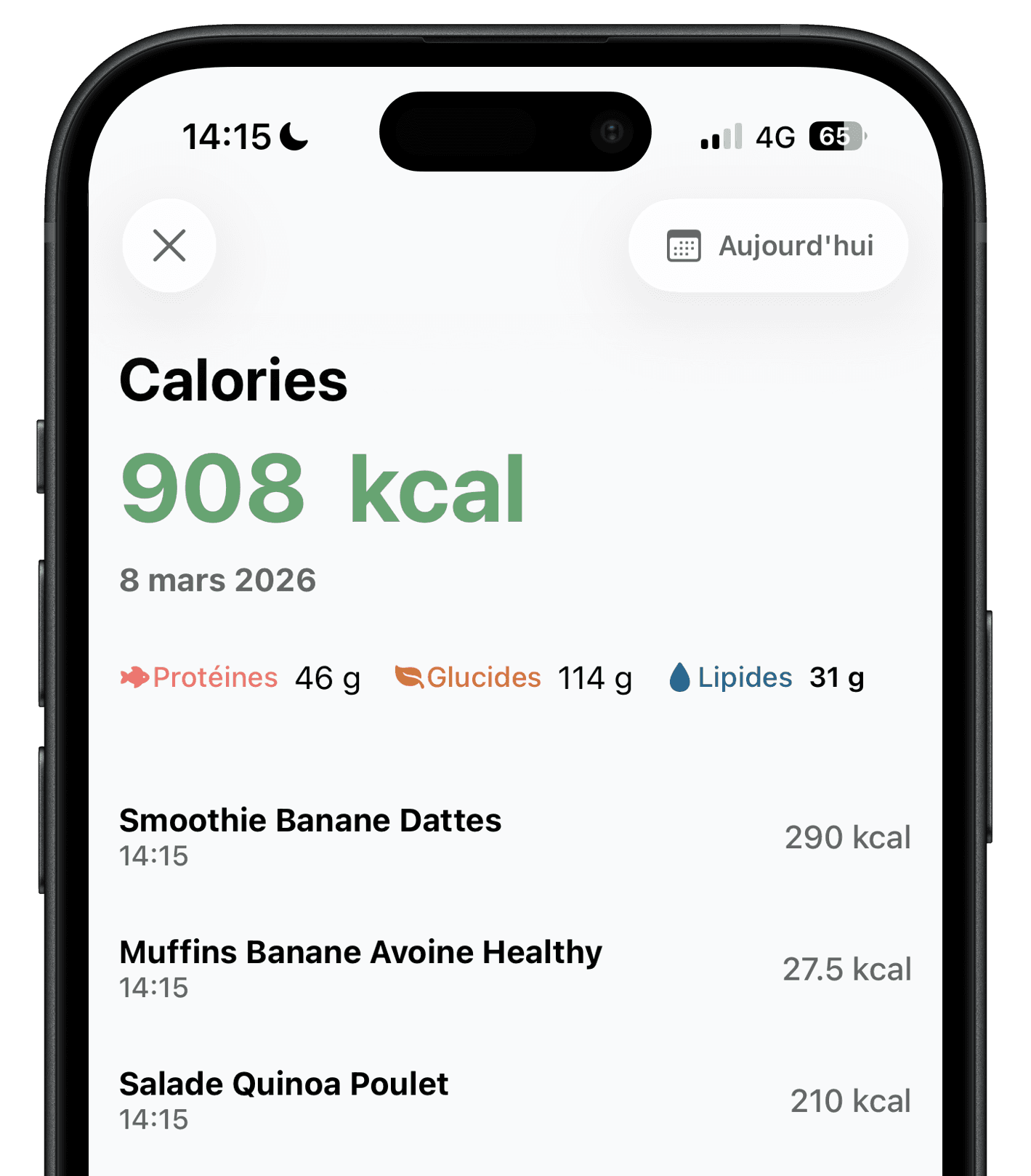
The easiest approach is to log what you eat without overthinking it. With Ember, you snap a photo of your snack or describe it in one sentence (“a large banana and a spoonful of peanut butter”): the calories and macros are added to your day, with your water, steps and weight in the same place.
Key takeaways
A 118 g medium banana without the peel has just over 100 kcal, 23 g of carbohydrate and 3 g of fibre; count about 70 kcal for an extra small one and 135 kcal for an extra large one. Weighed with the peel, it comes to only about 58 kcal per 100 g. Green or spotty, it keeps roughly the same calories: ripeness mostly changes the share of starch and sugars, and therefore the blood sugar response. Concentrated forms change everything: 365 kcal per 100 g of dried banana, around 500 kcal for chips. During exercise, bananas did as well as a sports drink in the available study, and when you want to lose weight, they remain an easy snack to count, as long as you keep an eye on what comes with them.
Sources
- ANSES. Table de composition nutritionnelle des aliments Ciqual 2025 : banane crue (13005), banane sèche, banane plantain crue et cuite.
- USDA FoodData Central (SR Legacy). Bananas, raw (FDC 173944), with banana chips, banana bread and fried plantain entries.
- Matvaretabellen (Mattilsynet). Banan, rå; banan, tørket, bananchips.
- Englyst HN, Cummings JH. Digestion of the carbohydrates of banana (Musa paradisiaca sapientum) in the human small intestine. American Journal of Clinical Nutrition, 1986.
- Hermansen K et al. Influence of ripeness of banana on the blood glucose and insulin response in type 2 diabetic subjects. Diabetic Medicine, 1992.
- University of Sydney. Glycemic Index Database (GI search): banana entries by ripeness.
- Nieman DC et al. Bananas as an energy source during exercise: a metabolomics approach. PLoS One, 2012.
- Jeukendrup A. A step towards personalized sports nutrition: carbohydrate intake during exercise. Sports Medicine, 2014.
- EFSA Panel on Dietetic Products, Nutrition and Allergies. Dietary reference values for potassium. EFSA Journal, 2016.
- NHS. 5 A Day portion sizes.
General information article, not a substitute for advice from a doctor or dietitian. Values from the Ciqual (ANSES), USDA FoodData Central and Matvaretabellen tables; calories per banana and per snack are estimates calculated by Ember from average weights, which vary with size, ripeness and added ingredients.
Frequently asked questions about banana calories
About 103 kcal for a 118 g medium banana without the peel (18 to 20 cm long), according to the Ciqual table. The USDA gives 105 kcal for the same size. It also provides 23 g of carbohydrate, including 18 g of sugars, and 3 g of fibre.
87.6 kcal per 100 g of raw banana without the peel according to Ciqual, 89 kcal according to the USDA and 88 kcal according to Matvaretabellen. If you weigh the banana with its peel, count about 58 kcal per 100 g, because the peel makes up roughly a third of the weight.
It depends on the peel. 150 g of peeled banana provides about 131 kcal. Weighed with the peel, 150 g of banana contains only about 99 g of flesh, or 87 kcal.
Not really: as a banana ripens, its starch turns into sugars, and food tables give a single value whatever the ripeness. A green banana may provide slightly fewer calories in practice, since part of its starch is not digested, but the gap has not been reliably measured. What mostly changes is blood sugar: a very ripe banana raises it more.
No, no more than any other food: what counts is your calorie balance over the day. With about 100 kcal and 3 g of fibre, a banana is a reasonable snack that counts as a portion of fruit. It is mostly banana chips, large amounts of dried banana and the extras (peanut butter, honey) that push the total up.
Plantain is richer in starch than a dessert banana: 132 kcal per 100 g raw and 125 kcal cooked according to Ciqual. Fried, it rises to 236 kcal per 100 g when ripe and up to 309 kcal when green, according to the USDA.
Nutrition · Mar 2
Understanding macronutrients
Proteins, carbs, fats: learn the role of each macro and how to balance them for your goal.
Nutrition · Oct 22
Egg calories: boiled, fried, scrambled and by size
Calories in an egg by size (S to XL), white vs yolk, cooking method and dishes (omelette, bacon), plus cholesterol and how many eggs a day.
Weight & fitness · Mar 6
Caloric deficit explained
Understand how to create a healthy, sustainable caloric deficit to lose weight without frustration.