Nutrition · October 22, 2026 · 14 min read
How many calories in an egg? Boiled, fried, scrambled
Egg calories by size (S, M, L, XL), in the white and the yolk, by cooking method and in your favourite dishes, plus what the research really says about cholesterol and how many eggs you can eat a day.
Egg calories: the numbers by size and cooking method
Published on October 22, 2026 · By the Ember team
In short
A medium egg contains about 70 kcal and 6.5 g of protein: France’s Ciqual food table lists 140 kcal per 100 g of raw egg. A small egg has around 60 kcal, a very large one around 95 kcal.
The yolk holds nearly three quarters of the calories and all of the cholesterol; the white has only about 16 kcal but more than half of the protein.
Hard-boiled, soft-boiled, poached or fried without fat, an egg keeps its 70 kcal. Butter, cheese and bacon are what push the total up: a three-egg cheese omelette tops 360 kcal.
For healthy people, one egg a day fits into a balanced diet according to the major reviews (AHA, Nordic review); take more care if you have high cholesterol or diabetes.
How many calories in an egg? It depends on the size
Eggs are one of the few foods we eat without a scale or a label: you crack one, cook it and guess. The good news is that they are also one of the easiest foods to estimate. According to Ciqual, the French national food composition table run by the food safety agency ANSES, 100 g of raw egg provides 140 kcal, 12.8 g of protein, 9.8 g of fat and almost no carbohydrate.
The real question is how much your egg weighs. The weight that defines its size includes the shell, which makes up about 12% of the total, so a 58 g medium egg holds only around 50 g of white and yolk. That is the figure that matters, and it works out to about 70 kcal for a medium egg, the size you find in most boxes.
The other big food tables agree: USDA FoodData Central lists 143 kcal per 100 g and Norway’s Matvaretabellen 149 kcal. These small gaps come from the hens’ feed, the share of yolk and lab methods. Per egg, they add up to a few calories, nothing that changes your day.
| Size (weight in shell) | Edible part | Calories | Protein | Cholesterol |
|---|---|---|---|---|
| S, small (under 53 g) | ≈ 42 g | ≈ 59 kcal | 5.4 g | ≈ 157 mg |
| M, medium (53 to 63 g) | ≈ 51 g | ≈ 71 kcal | 6.5 g | ≈ 190 mg |
| L, large (63 to 73 g) | ≈ 60 g | ≈ 84 kcal | 7.7 g | ≈ 223 mg |
| XL, very large (73 g and over) | ≈ 67 g | ≈ 94 kcal | 8.6 g | ≈ 249 mg |
Ember’s calculation from the Ciqual table (raw egg: 140 kcal, 12.8 g protein and 372 mg cholesterol per 100 g), for eggs weighing 48, 58, 68 and 76 g in their shell, 88% of which is edible (the share used by Matvaretabellen). Sizes: EU egg marketing rules, where XL is officially called “very large”.
Keep one simple rule in mind: count 60, 70, 85 or 95 kcal for a small, medium, large or very large egg. Watch out with American recipes: a US “large” egg weighs about 50 g without the shell, which is closer to a European medium (72 kcal according to the USDA).
Egg white vs yolk: where are the calories?
Cut an egg in half and the split is surprising. The white makes up about two thirds of the weight, but it is almost nothing but water and protein: about 16 kcal in the white of a medium egg, with no fat and no cholesterol. The yolk is only a third of the egg, yet it carries nearly three quarters of the calories, all of the fat and all of the cholesterol.
Protein is shared more evenly than most people think: the white provides a little over half (3.7 g) and the yolk the rest (2.6 g). That is why egg white omelettes are so popular with gym-goers: you keep a good chunk of the protein for a fraction of the calories.
| Part (medium egg) | Weight | Calories | Protein | Fat | Cholesterol |
|---|---|---|---|---|---|
| White | ≈ 34 g | ≈ 16 kcal | 3.7 g | 0.1 g | 0 mg |
| Yolk | ≈ 17 g | ≈ 52 kcal | 2.6 g | 4.5 g | ≈ 160 mg |
| Whole egg | ≈ 51 g | ≈ 71 kcal | 6.5 g | 5 g | ≈ 190 mg |
Ciqual values for raw egg white (48 kcal per 100 g) and raw yolk (307 kcal per 100 g). The two-thirds white, one-third yolk split comes from the USDA reference weights (33 g and 17 g in a 50 g egg). White plus yolk differs slightly from the whole egg because they are separate analyses.
Don’t throw the yolk away too quickly, though. It contains almost all of the egg’s choline, vitamin D, vitamin A and vitamin B12. A smart compromise is to mix one whole egg with one or two extra whites: more protein without doubling the calories.
Boiled, soft-boiled, poached, fried: egg calories by cooking method
It is one of the most common questions: does a hard-boiled egg have more calories than a raw one? No. Cooking in water adds nothing, so a hard-boiled, soft-boiled or poached egg keeps its roughly 70 kcal. The small differences in the Ciqual table (134 kcal per 100 g for hard-boiled, 142 for soft-boiled) reflect water content and the samples analysed, not an effect of cooking. A jammy six-minute egg sits somewhere in between.
An egg fried dry in a non-stick pan shows 157 kcal per 100 g. That higher figure is misleading: some water evaporates, so the egg weighs less, but it holds exactly the same calories it had before it hit the pan.
Fat changes everything. An egg fried with a drizzle of oil or a knob of butter soaks up 15 to 20 kcal of fat on average, according to measurements from the USDA and Matvaretabellen. And if you baste the yolk with melted butter or mop up the leftover oil with toast, you are eating the rest of the spoonful too.
| Preparation | Per 100 g | Per medium egg | What changes |
|---|---|---|---|
| Raw | 140 kcal | ≈ 71 kcal | The baseline |
| Hard-boiled | 134 kcal | ≈ 68 kcal | Nothing added |
| Soft-boiled | 142 kcal | ≈ 72 kcal | Nothing added |
| Poached | 139 kcal | ≈ 71 kcal | Nothing added (water and a dash of vinegar) |
| Fried without fat | 157 kcal | ≈ 71 kcal | Some water evaporates: denser, not more caloric |
| Fried with a little fat | ≈ 200 kcal | ≈ 90 kcal | +15 to 20 kcal of absorbed fat |
Per 100 g: Ciqual table (raw, hard-boiled, soft-boiled, poached, fried without fat). With fat: USDA (196 kcal per 100 g, 90 kcal for a large fried egg) and Matvaretabellen (207 kcal per 100 g). Per medium egg column: Ember’s calculation for 51 g of raw egg.
To count accurately, take the egg at 70 kcal, then add whatever goes into the pan: 38 kcal for a teaspoon of butter (5 g) and 90 kcal for a tablespoon of oil (10 g).
Omelette, scrambled eggs, bacon and eggs: how many calories?
In real life, we rarely eat a single egg on its own. An omelette, scrambled eggs or a plate of bacon and eggs usually means two or three eggs, some fat and a filling. The eggs are the base, but butter, cheese and cured meat are what separate a 200 kcal meal from a 400 kcal one.
The table covers common homemade versions. Bacon deserves a note: streaky bacon, cut from the belly and fried until crisp, tops 450 kcal per 100 g, while very lean cured loin, such as the French “filet de bacon” or Canadian bacon, has only 118 kcal per 100 g according to Ciqual. Two plates with the same name can therefore be 70 kcal apart.
| Dish | What we counted | Calories | Protein |
|---|---|---|---|
| Scrambled eggs | 2 medium eggs, 5 g butter, 2 tbsp milk | ≈ 195 kcal | 14 g |
| Plain omelette, 2 eggs | 2 medium eggs, 5 g butter | ≈ 180 kcal | 13 g |
| Plain omelette, 3 eggs | 3 medium eggs, 5 g butter | ≈ 250 kcal | 19.5 g |
| Cheese omelette, 3 eggs | 3 medium eggs, 5 g butter, 30 g grated Emmental | ≈ 360 kcal | 28 g |
| Omelette with lardons | 2 medium eggs, 40 g smoked lardons | ≈ 255 kcal | 19 g |
| Bacon and eggs, streaky bacon | 2 fried eggs, 2 rashers of crispy bacon (≈ 23 g) | ≈ 285 kcal | 21 g |
| Bacon and eggs, lean bacon | 2 fried eggs, 3 slices of lean cured loin (≈ 30 g) | ≈ 215 kcal | 20 g |
Ember’s estimates. Ingredients: Ciqual table (butter 753 kcal, grated Emmental 368 kcal, cooked smoked lardons 277 kcal, “filet de bacon” 118 kcal per 100 g); crispy streaky bacon: USDA (468 kcal per 100 g, 11.5 g per slice). The weight of the lean slices is an estimate. Fried egg with fat counted at 90 kcal.
On the protein side, a three-egg cheese omelette delivers almost 28 g, a big share of what you need in a day: to see how that compares with your needs, read our guide on how much protein per day. To lighten things up without losing the pleasure, use a non-stick pan, a smaller amount of a stronger cheese and plenty of vegetables.
Protein, choline, vitamin D, B12: what an egg really gives you
For 70 kcal, an egg offers a rare nutritional profile. Its 6.5 g of protein contains all the essential amino acids in proportions close to human needs, which is why egg protein has long been used as a benchmark for protein quality.
The most underrated nutrient is choline, which supports the liver, the brain and cell membranes. According to the USDA, a medium egg provides about 150 mg, almost all of it in the yolk. EFSA, the European Food Safety Authority, sets an adequate intake of 400 mg a day for adults (480 mg during pregnancy, 520 mg while breastfeeding), so a single egg covers more than a third of that reference.
Eggs are also one of the few foods that naturally contain vitamin D: about 1 µg per medium egg according to Ciqual, a little more in Norwegian eggs (close to 1.4 µg according to Matvaretabellen), against a European reference of 15 µg a day. It is a useful top-up, not a solution, especially in winter: our guide on vitamin D deficiency covers the other sources. Add 0.5 to 0.7 µg of vitamin B12 depending on the table (the reference is 4 µg), plus vitamin A and iodine, and it is easy to see why eggs are so often recommended to people who eat little meat.
Eggs and cholesterol: what the research really says in 2026
For decades, eggs had a bad reputation: one yolk contains about 190 mg of cholesterol, and it was assumed that this cholesterol went straight into your arteries. Advice has moved on a lot since then, because the liver makes most of the cholesterol in your blood and adjusts its output depending on what you eat.
In Europe, EFSA decided back in 2010 not to set a reference value for dietary cholesterol, beyond limiting saturated fat. In the United States, the American Heart Association (AHA) published a science advisory concluding that observational studies generally show no significant link between dietary cholesterol and cardiovascular disease, while noting that intervention trials often tie high cholesterol intakes to higher LDL. It recommends focusing on the overall eating pattern, such as a Mediterranean-style diet, rather than on a number.
The large studies point the same way, with nuances. In 2020, an analysis of three US cohorts (more than 215,000 people followed for up to 32 years), backed by a meta-analysis of 1.7 million participants, found no association between one egg a day and cardiovascular risk. On the other hand, a 2019 study in JAMA of nearly 30,000 Americans linked each extra half egg a day to a 6% higher cardiovascular risk, a link that vanished once total dietary cholesterol was taken into account.
The review carried out for the 2023 Nordic Nutrition Recommendations sums up current knowledge well: eggs can raise blood cholesterol slightly, with big differences from one person to the next, but one egg a day is unlikely to increase disease risk, especially in European studies. To understand what really moves your LDL, read our guide on cholesterol and diet.
How many eggs a day can you eat?
There is no single official number, but the guidance lines up. The AHA considers that healthy people can include up to one whole egg a day in a healthy diet, and that older adults with normal cholesterol can go up to two. In France, Santé.fr, the public health information service, says that two eggs a day seem fine for people with no particular risk, provided they get their cholesterol checked, and advises 3 or 4 eggs a week for people with high cholesterol, diabetes or cardiovascular risk. The Nordic review also points out that there is little data above one egg a day.
Context matters as much as the number. Two poached eggs on wholegrain toast with salad do not have the same effect as two fried eggs surrounded by bacon, sausages and buttered white bread: it is mostly the saturated fat and processed meat around the egg that weigh on the balance. For vegetarians, eggs are a valuable ally, since they are one of the few sources of vitamin B12 outside meat and fish.
One last precaution, this time about food safety: France’s food safety agency ANSES advises pregnant women, young children, older people and people with weakened immunity not to eat raw or undercooked eggs (homemade mayonnaise, chocolate mousse, very runny yolks) because of the risk of salmonella. If you take cholesterol-lowering medication, your doctor is the right person to set your amount.
Eggs and weight loss: satiety, studies and meal ideas
Eggs have a real card to play when you are watching your weight: plenty of protein, few calories and a well-documented filling effect. In a study published in 2005, 30 women with overweight ate either an egg breakfast or a bagel breakfast with the same calories and the same weight. After the eggs, they felt fuller and ate about 575 kcal at lunch, against 740 after the bagel, and their intake stayed lower for 36 hours.
In 2008, the same team followed 152 adults with overweight for eight weeks. Combined with a diet set at a 1,000 kcal daily deficit, the two-egg breakfast (340 kcal including toast) led to a loss of 2.6 kg against 1.6 kg with bagels, 65% more, with no effect on blood cholesterol. Without a diet, however, eggs alone did not lead to weight loss. Both small studies were funded by the American Egg Board, the US egg industry body: they show an interesting satiety effect, not a miracle fix. For more morning ideas, our guide to a low-calorie breakfast has plenty.
- The filling breakfast, ≈ 230 kcal
Two hard-boiled or soft-boiled eggs and a 40 g slice of wholemeal bread: about 230 kcal and 17 g of protein. Boil the eggs the night before for busy mornings: they keep for a few days in the fridge in their shells.
- The veggie omelette, ≈ 250 kcal
Two eggs, a knob of butter and a big handful of sautéed vegetables (spinach, mushrooms, peppers): around 250 kcal depending on the vegetables, for a dinner ready in ten minutes. Add cheese by the spoonful, not the handful.
- One egg plus two whites, ≈ 105 kcal
Mixing one whole egg with two whites gives about 14 g of protein for 105 kcal, against 13 g and 142 kcal for two whole eggs. A handy trick if you eat eggs every day.
- Count the pan, not just the egg
Cooking fat is the most common blind spot: a tablespoon of oil (90 kcal) outweighs a whole egg. Measure it once with a real spoon to see how much you usually pour.
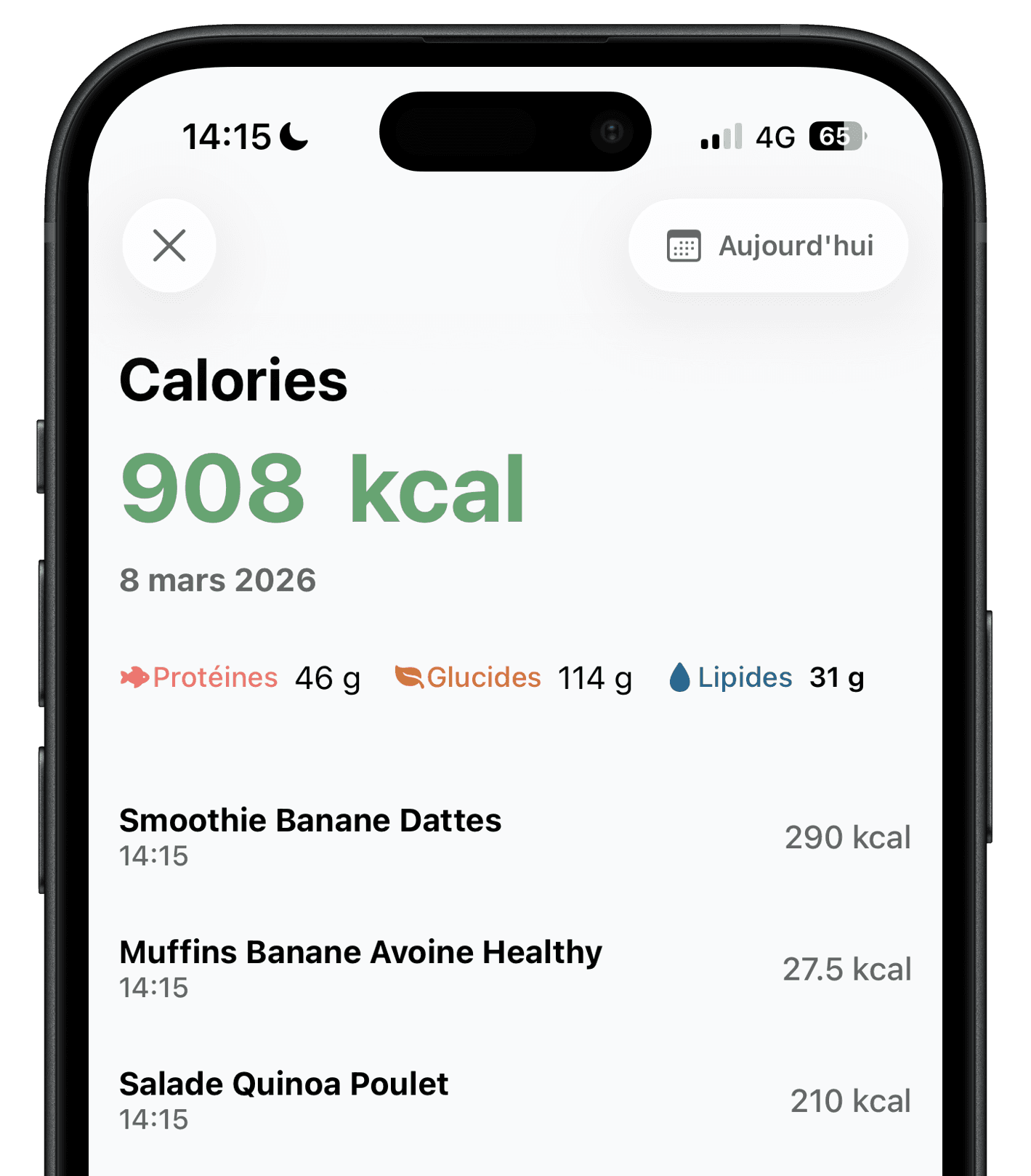
The simplest approach is to log what you eat without overthinking it. With Ember, you snap a photo of your plate or describe your omelette in one sentence (“3 eggs, some cheese, a knob of butter”): the calories and macros are added to your day, alongside your water, steps and weight in one place.
Key takeaways
A medium egg provides about 70 kcal and 6.5 g of protein; count 60 kcal for a small egg and 95 kcal for a very large one. The yolk holds three quarters of the calories, all of the cholesterol and most of the vitamins, while the white supplies a good share of the protein for just 16 kcal. Hard-boiled, soft-boiled, poached or fried without fat, an egg keeps its calories: butter, oil, cheese and bacon are what turn a 150 kcal plate into a 350 kcal meal. For healthy people, one egg a day fits comfortably into a balanced diet according to the major reviews available today. If you have high cholesterol, diabetes or heart disease, ask your doctor to help you set the amount that suits you.
Sources
- ANSES. Table de composition nutritionnelle des aliments Ciqual 2020 : œuf cru, blanc, jaune, dur, à la coque, poché, au plat, omelettes.
- USDA FoodData Central (SR Legacy). Egg, whole, raw, fresh (FDC 171287), with white, yolk, fried, hard-boiled and bacon entries.
- Matvaretabellen 2026 (Mattilsynet). Egg, rå; egg, stekt i fett; eggehvite; eggeplomme.
- Commission Regulation (EC) No 589/2008, article 4: grading of class A eggs by weight (bands kept by Delegated Regulation (EU) 2023/2465).
- Carson JAS et al. Dietary Cholesterol and Cardiovascular Risk: A Science Advisory From the American Heart Association. Circulation, 2020.
- Drouin-Chartier JP et al. Egg consumption and risk of cardiovascular disease: three large prospective US cohort studies, systematic review, and updated meta-analysis. BMJ, 2020.
- Virtanen JK, Larsson SC. Eggs: a scoping review for Nordic Nutrition Recommendations 2023. Food & Nutrition Research, 2024.
- Vander Wal JS et al. Egg breakfast enhances weight loss. International Journal of Obesity, 2008.
General information article that does not replace advice from a doctor or dietitian. Values come from the Ciqual (ANSES), USDA FoodData Central and Matvaretabellen tables; calories per egg and per dish are estimates calculated by Ember from average weights, which vary with egg size, recipe and the amount of cooking fat.
Frequently asked questions about egg calories
About 70 kcal for a medium hard-boiled egg (Ciqual: 134 kcal per 100 g). Count 55 to 60 kcal for a small egg and about 90 kcal for a very large one. Boiling adds no calories: only the size changes the figure.
Two medium eggs provide about 140 kcal and 13 g of protein when cooked without fat (hard-boiled, poached, soft-boiled). Fried with a little oil or butter, or as an omelette with a knob of butter, count about 180 kcal; scrambled with butter and a splash of milk, about 195 kcal.
About 16 kcal in the white of a medium egg (34 g), with 3.7 g of protein and almost no fat. The yolk provides about 52 kcal, along with all of the cholesterol and most of the egg’s vitamins.
Only because of the fat. Fried dry in a non-stick pan, it has the same 70 kcal or so. With a drizzle of oil or butter, it soaks up 15 to 20 kcal more on average, and more if the pan is swimming in fat.
For healthy people, yes: the AHA considers that one egg a day fits into a healthy diet, and a meta-analysis of 1.7 million participants found no increase in cardiovascular risk at that level. With high cholesterol, diabetes or cardiovascular risk, the French public health portal Santé.fr suggests 3 to 4 eggs a week instead: talk to your doctor.
No single food makes you gain weight on its own: what counts is your energy balance over the day. With 70 kcal and 6.5 g of protein, an egg is actually quite filling. It is mostly the extras (butter, cheese, bacon, buttered toast) that weigh down the plate.
No, the difference is negligible. In Norway’s Matvaretabellen, a raw organic egg has 146 kcal per 100 g against 149 for a standard egg. Farming method and feed mostly affect certain nutrients, such as vitamin D (4 µg against 2.5 µg per 100 g in that table).
Nutrition · Mar 2
Understanding macronutrients
Proteins, carbs, fats: learn the role of each macro and how to balance them for your goal.
Nutrition · Mar 3
Essential micronutrients
Vitamins, minerals, trace elements: discover why these nutrients are vital to your health.
Weight & fitness · Mar 6
Caloric deficit explained
Understand how to create a healthy, sustainable caloric deficit to lose weight without frustration.