Nutrition · October 22, 2026 · 12 min read
How much protein per day? The chart by body weight and profile
From 0.83 g per kilo in Europe to 1.2–1.6 g in the new US guidelines: what you actually need, in grams, for your weight, activity and age, and the foods that get you there.
How much protein per day: the numbers, profile by profile
Published on October 22, 2026 · By the Ember team
In short
How much protein per day? The European reference is 0.83 g per kilo of body weight, or 58 g for someone weighing 70 kg (EFSA): a minimum that prevents deficiency.
The new US Dietary Guidelines released in January 2026 aim for 1.2 to 1.6 g/kg (84 to 112 g at 70 kg), the same range that helps you lose weight without losing muscle.
For muscle gain, results level off around 1.6 g/kg; after 65, aim for at least 1 g/kg. Spread it over 3 or 4 meals of 25 to 40 g.
How much protein per day by body weight (50 to 110 kg)
Protein needs are expressed in grams per kilo of body weight per day, so the maths is simple: multiply your weight by the right factor. The hard part is choosing that factor, because there are two families of numbers and they answer different questions.
The first is the physiological minimum: 0.83 g/kg according to the European Food Safety Authority (EFSA), a value set to cover the needs of almost all healthy adults. It keeps you out of deficiency, nothing more. The second is the useful range for a specific goal (keeping muscle as you age, building it, losing fat), which studies place between 1.2 and 2 g/kg. The chart below gives both, from 50 to 110 kg. For what protein does in the body, protein quality and common myths, see our complete guide to protein.
| Weight | 0.83 g/kg (EU minimum) | 1 g/kg (over 65) | 1.2–1.6 g/kg (US 2026, weight loss) | 1.6–2 g/kg (muscle gain) |
|---|---|---|---|---|
| 50 kg | 42 g | 50 g | 60–80 g | 80–100 g |
| 60 kg | 50 g | 60 g | 72–96 g | 96–120 g |
| 70 kg | 58 g | 70 g | 84–112 g | 112–140 g |
| 80 kg | 66 g | 80 g | 96–128 g | 128–160 g |
| 90 kg | 75 g | 90 g | 108–144 g | 144–180 g |
| 100 kg | 83 g | 100 g | 120–160 g | 160–200 g |
| 110 kg | 91 g | 110 g | 132–176 g | 176–220 g |
Calculation: weight × factor, rounded to the nearest gram. 0.83 g/kg: EFSA and ANSES reference for adults. 1 g/kg: ANSES and DGE reference from age 65. 1.2–1.6 g/kg: US Dietary Guidelines 2025–2030 and weight-loss research. 1.6–2 g/kg: muscle gain (gains level off around 1.6 g/kg, ISSN range up to 2 g/kg).
One important caveat if you carry extra weight: these factors apply to a “normal” body weight. The German Nutrition Society (DGE) points out that body fat does not raise protein needs, so with a high BMI you calculate on the weight you would have at a normal BMI, or on your goal weight. Someone who weighs 110 kg and is 1.75 m tall does not need to aim for 176 g a day: working from about 75 kg is more accurate.
Protein needs by profile: sedentary, active, weight loss, over 65
Weight is only part of the story: age, physical activity and your goal all move the target. Here are the best-supported ranges, with the example of a 70 kg adult and the body or study behind each figure.
| Profile | g/kg/day | At 70 kg | Reference |
|---|---|---|---|
| Sedentary adult | 0.83 | 58 g | EFSA, ANSES, NNR 2023, AESAN (DGE: 0.8) |
| Recreational exercise (2 to 4 sessions a week) | 0.83 to 1.2 | 58 to 84 g | DGE: 0.8 is enough; US 2026: at least 1.2 |
| Intense or endurance training (5+ hours a week) | 1.2 to 2 | 84 to 140 g | ISSN and ACSM, cited by the DGE |
| Strength training, muscle gain | 1.6 to 2 | 112 to 140 g | Morton 2018, ISSN 2017 |
| Weight loss | 1.2 to 1.6 | 84 to 112 g | Leidy 2015, US 2026 |
| Over 65 | 1 to 1.2 | 70 to 84 g | ANSES and DGE: 1; NNR: 1.2; PROT-AGE: 1 to 1.2 |
Ranges for healthy adults, calculated on a normal body weight. Pregnancy: EFSA adds 1 g, 9 g and then 28 g a day depending on the trimester.
The case of weekend exercisers often surprises people: for two or three sessions a week, the DGE considers 0.8 g/kg to be enough. Needs really climb from around five hours of training a week, or when you are deliberately trying to build muscle. The meta-analysis by Morton and colleagues (49 trials, 1,863 participants) found that beyond 1.62 g/kg, extra protein brought no further measurable gain in lean mass in people doing resistance training.
After 65, muscle responds less well to each protein-rich meal, a phenomenon called anabolic resistance. That is why France's ANSES (in 2019) and Germany's DGE (in 2017) raised their reference to 1 g/kg, and why the European expert group PROT-AGE recommends at least 1 to 1.2 g/kg, and 1.2 g/kg or more for older adults who stay active.
The 2026 US guidelines: why 1.2 to 1.6 g/kg when Europe says 0.83?
On January 7, 2026, the US Department of Health and Human Services (HHS) and the Department of Agriculture (USDA) released the Dietary Guidelines for Americans 2025–2030. The document replaces the plate with an inverted pyramid: the wide top brings together protein, dairy and healthy fats alongside vegetables and fruits, while whole grains sit at the narrow tip. It tells Americans to “prioritize protein foods at every meal” and sets a goal of 1.2 to 1.6 g per kilo per day, adjusted to individual calorie needs. The change does not touch the US Recommended Dietary Allowance (RDA), which remains 0.8 g/kg.
No European authority has followed. EFSA keeps 0.83 g/kg for all adults, older adults included, and the scientific committee of Spain's food safety agency AESAN adopted EFSA's values for macronutrients. France's ANSES also stays at 0.83 g/kg and expresses it as a share of energy: 10 to 20% of calories. The Nordic Nutrition Recommendations 2023, used by Norway among others, say the same and only go up to about 1.2 g/kg for planning the meals of people over 70. In Germany, the DGE stays at 0.8 g/kg before age 65.
| Authority | Adults | Over 65 | Date |
|---|---|---|---|
| United States (USDA, HHS) | 1.2 to 1.6 g/kg (goal) | No specific figure | January 2026 |
| European Union (EFSA) | 0.83 g/kg | 0.83 g/kg | 2012 |
| France (ANSES) | 0.83 g/kg, 10 to 20% of energy | 1 g/kg | 2007, 2016, 2019 |
| Germany (DGE) | 0.8 g/kg | 1 g/kg (estimated value) | 2017 |
| Spain (AESAN) | EFSA values (0.83 g/kg) | 0.83 g/kg | 2019 |
| Nordic countries (NNR 2023) | 0.83 g/kg, 10 to 20% of energy | About 1.2 g/kg for meal planning (over 70) | 2023 |
Values checked against the official documents in October 2026. EFSA, ANSES and the DGE have not set any upper limit.
These figures contradict each other less than it seems. The European references answer “how much do you need to avoid falling short?”, the US target answers “how much should you aim for in a diet built on whole foods?”. There is still a real difference: for a 70 kg person eating 2,000 kcal, 1.6 g/kg means 112 g of protein, or about 22% of calories, above the 20% ceiling used by ANSES and the Nordic countries. Aiming for around 1.2 g/kg (17% of calories in this example) fits both approaches.
How much protein is in food? Chart by portion, animal and plant
Hitting 80 or 110 g a day feels abstract until you turn it into meals. A chicken breast already covers more than a third, but pulses, tofu and dairy do the job very well too. The values below come from the French Ciqual food composition table (ANSES), applied to everyday portions.
| Food | Portion | Protein | Calories |
|---|---|---|---|
| Grilled chicken breast | 120 g | 36 g | 170 kcal |
| Salmon, cooked | 120 g | 28 g | 245 kcal |
| Tuna in water, drained | 100 g | 27 g | 145 kcal |
| Lean beef mince (5% fat), cooked | 100 g | 26 g | 155 kcal |
| Seitan | 100 g | 21 g | 135 kcal |
| Green lentils, cooked | 200 g | 20 g | 250 kcal |
| Cooked ham | 90 g | 19 g | 100 kcal |
| Plain tofu | 125 g | 17 g | 185 kcal |
| Tempeh | 100 g | 16 g | 155 kcal |
| Hard-boiled eggs | 2 eggs (110 g) | 15 g | 145 kcal |
| Fat-free fromage frais | 200 g | 15 g | 95 kcal |
| Chickpeas, cooked | 150 g | 12 g | 220 kcal |
| Pasta, cooked | 200 g | 12 g | 335 kcal |
| Semi-skimmed milk | 250 ml | 9 g | 120 kcal |
| Emmental | 30 g | 8 g | 110 kcal |
| Plain soy drink | 250 ml | 8 g | 105 kcal |
| Rolled oats | 40 g | 7 g | 150 kcal |
| Almonds | 30 g | 6 g | 185 kcal |
| Wholemeal bread | 2 slices (60 g) | 5 g | 140 kcal |
| Plain yoghurt | 125 g | 5 g | 65 kcal |
Ciqual (ANSES) values per 100 g, multiplied by a portion estimated by Ember; calories rounded to 5 kcal. Foods weighed cooked when eaten cooked. Milk and soy drink: 250 ml counted as 250 g.
Plant sources hold up well on quantity: 200 g of cooked lentils give you 20 g of protein, more than 90 g of cooked ham, with fibre as a bonus. The difference lies in quality: according to ANSES, cereals are low in lysine and pulses in sulphur amino acids. But the agency sees no need to combine them systematically at the same meal; varying pulses, whole grains, soy and nuts over the day is enough. In March 2025 it published food guidelines showing that vegetarian and vegan adults can cover their protein needs.
Two caveats if you eat no animal products at all. Plant proteins are slightly less digestible, so aiming for the top of your range is a sensible precaution. And seitan, tofu and tempeh are the most concentrated plant sources: having one of them at one or two meals a day makes the numbers much easier.
How much protein per meal? The 25 to 40 g threshold
Your daily total matters most, but how you spread it is not neutral. Muscle responds to each protein intake with a burst of synthesis, and that response is clearly stronger when the meal brings enough. The International Society of Sports Nutrition (ISSN) recommends 0.25 g/kg per serving, or 20 to 40 g, every 3 to 4 hours. Older adults need a larger dose: about 0.4 g/kg per meal in the work of Moore and colleagues, compared with 0.24 g/kg in young adults.
Yet a typical day often does the opposite: a breakfast under 10 g (toast and coffee), a decent lunch and a very protein-heavy dinner. Boosting breakfast is the simplest way to add 15 to 20 g without changing anything else. Here is a day at about 110 g, for a 70 kg person aiming for 1.6 g/kg.
| Meal | What's on the plate | Protein |
|---|---|---|
| Breakfast | 200 g fat-free fromage frais, 40 g rolled oats, 30 g almonds | 28 g |
| Lunch | 200 g cooked lentils, 2 hard-boiled eggs, raw vegetables | 35 g |
| Snack | 2 slices wholemeal bread, 30 g Emmental | 13 g |
| Dinner | 120 g salmon, 150 g cooked quinoa, vegetables | 35 g |
| Total | About 1,550 kcal, not counting vegetables and added fats | 111 g |
Calculated from the Ciqual values in the food chart; cooked quinoa: 7 g of protein per 150 g.
The old myth of “30 g maximum per meal” no longer holds: in 2023, a team at Maastricht University showed that 100 g of protein after exercise produced a larger and longer response (more than 12 hours) than 25 g. Nothing is wasted; three or four well-stocked meals are simply easier to digest and organise than one huge one. If you train, the meal after your session is a good moment for one of these doses, as we explain in our article on muscle recovery.
Protein and weight loss: satiety and muscle in a calorie deficit
When you eat less, your body draws on its fat stores, but also on its muscle. Protein acts as a safety net here. A 2015 review in the American Journal of Clinical Nutrition by eight researchers, including Heather Leidy and Arne Astrup, concluded that diets providing 1.2 to 1.6 g/kg, ideally with 25 to 30 g per meal, improve appetite, weight control and several cardiometabolic markers. Meta-analyses of short trials show more fat loss and better preservation of lean mass than with lower-protein diets.
It pays to keep your feet on the ground, though. The filling effect is real but modest: people feel fuller after a protein-rich meal, without eating clearly less at the next one in the trials. The DGE also notes that the advantage of a high-protein diet on the scales, clear over three to six months, fades over time. Protein does not make you lose weight on its own: it makes a calorie deficit more comfortable and safer for your muscles.
If you lift weights while cutting, the ISSN mentions higher intakes, 2.3 to 3.1 g/kg, to keep as much muscle as possible in trained lifters. These are special cases; for the vast majority, 1.2 to 1.6 g/kg calculated on a sensible body weight is enough.
How much protein is too much?
No authority has set an upper limit. EFSA and ANSES both consider the data insufficient to define a safe upper intake. EFSA does state, however, that intakes up to twice its reference, about 1.7 g/kg, are regularly eaten by active, healthy adults in Europe and are considered safe. The DGE adds that intakes three to four times the reference have been observed without symptoms over long periods, while noting, as the WHO does, that this does not prove they are risk-free.
In practice, beyond about 1.6 g/kg, extra protein no longer builds measurable muscle, but it still brings 4 kcal per gram. The real risk lies elsewhere: a menu built around shakes and bars leaves less room for fibre, fruit and vegetables, and many high-protein products are ultra-processed foods sold at a premium. If your intake is high, drink enough: the urea produced when protein is broken down leaves the body in urine.
One important exception: with chronic kidney disease, your protein intake should be decided with your doctor, who may in fact lower it. The PROT-AGE group makes the same point for older adults whose kidney function is severely reduced.
Action plan: 6 habits to hit your protein target
- Work out your target once
Multiply your weight (or a weight matching a normal BMI if you carry extra weight) by the factor for your profile. The result in grams is a daily guide, not a rule to follow to the gram.
- Upgrade your breakfast
Fromage frais, eggs, soy drink or cheese on toast: going from 8 to 25 g in the morning is the most effective way to balance your day.
- A protein source at every meal
Meat, fish, eggs, tofu or pulses: aim for 25 to 40 g per main meal, as suggested by the ISSN and the new US guidelines.
- Keep ready-to-eat protein at hand
Hard-boiled eggs, tuna in water, jarred lentils, fromage frais: enough to complete a meal in two minutes without relying on protein bars.
- Make room for pulses
Lentils, chickpeas and beans bring protein, fibre and fullness at a low cost. A few meals a week are enough to make a difference.
- Track for a few days, not all year
Logging what you eat for one week is often enough to spot the meal that falls short. After that, the right habits become automatic.
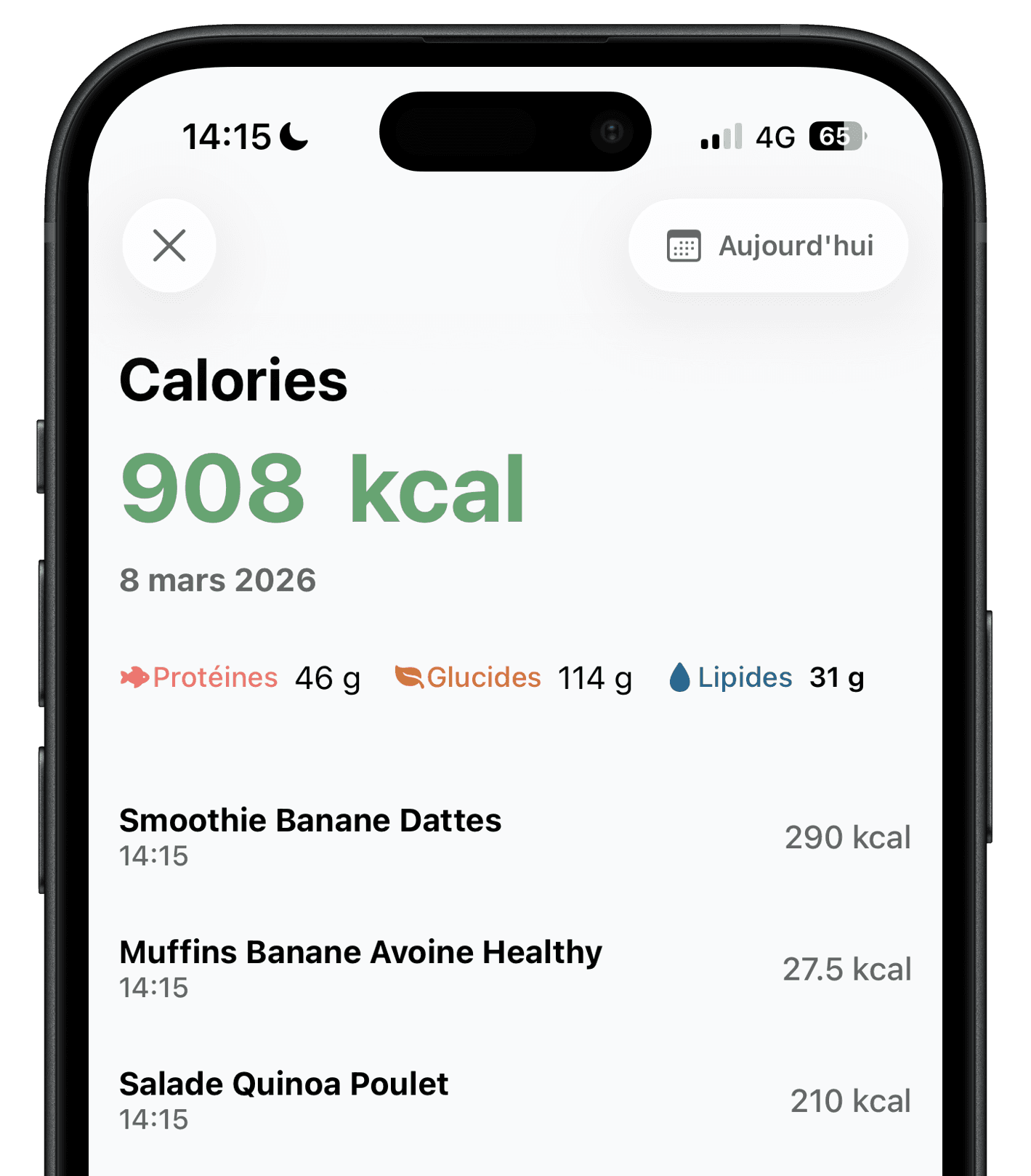
The hard part is not knowing your target, it is knowing where you stand. With Ember, snap a photo of your plate, describe it in one sentence or scan a barcode: protein, the other macros and calories are added to your day, and you can see straight away if you are 20 g short at dinner.
Key takeaways
The European reference is 0.83 g of protein per kilo per day, about 58 g for a 70 kg adult, and it covers the needs of most sedentary adults. The new US guidelines from January 2026 aim higher, at 1.2 to 1.6 g/kg, a range that also matches what helps you lose weight while keeping your muscle. For strength training, gains level off around 1.6 g/kg, and after 65 it is wise to aim for at least 1 g/kg. Spread your total over three or four meals of 25 to 40 g, starting with breakfast, and calculate on a sensible weight if you are overweight. If you have kidney disease, are pregnant or have a specific medical situation, have your target checked by a doctor or dietitian.
Sources
- USDA and HHS, Dietary Guidelines for Americans 2025–2030 (January 2026).
- EFSA, EFSA sets population reference intakes for protein (2012).
- ANSES, Les protéines : références nutritionnelles et sources.
- Helsedirektoratet, reference values based on the Nordic Nutrition Recommendations 2023 (energy-giving nutrients).
- DGE, Wie viel Protein brauchen wir? New protein reference values (2017).
- Jäger R. et al. International Society of Sports Nutrition Position Stand: protein and exercise. J Int Soc Sports Nutr, 2017.
- Leidy H. J. et al. The role of protein in weight loss and maintenance. Am J Clin Nutr, 2015.
- ANSES, Ciqual food composition table (2025).
General information that does not replace advice from a doctor or dietitian. Recommendations checked against the official documents in October 2026. Food values: Ciqual (ANSES) averages multiplied by portions estimated by Ember; needs by weight: rounded calculations.
Frequently asked questions about daily protein
Needs per kilo are the same as for men: 0.83 g/kg for a sedentary woman, about 50 g at 60 kg. With regular exercise or a weight-loss goal, 1.2 to 1.6 g/kg, or 72 to 96 g at 60 kg. During pregnancy, EFSA adds 1 g, 9 g and then 28 g a day depending on the trimester.
With regular strength training, aim for about 1.6 g/kg: beyond that level, the Morton meta-analysis (2018) found no further gain in lean mass. The ISSN gives a range of 1.4 to 2 g/kg. At 80 kg, that means 128 to 160 g a day, spread over 4 servings.
Between 1.2 and 1.6 g/kg, calculated on a weight matching a normal BMI if you are overweight, with 25 to 30 g per meal. This range helps preserve muscle and fullness during a calorie deficit, but it does not cause weight loss on its own.
About 20 to 40 g, or 0.25 g/kg per meal according to the ISSN. After 65, the useful dose rises to about 0.4 g/kg per meal. A bigger protein meal is not wasted, but three or four regular servings are easier to organise.
At least 1 g/kg according to France's ANSES and Germany's DGE, or 70 g at 70 kg. The Nordic recommendations use about 1.2 g/kg for planning the meals of people over 70, and the PROT-AGE group advises 1 to 1.2 g/kg, more for active or ill older adults, except in severe kidney disease.
For a healthy adult there is no official upper limit: EFSA considers intakes up to twice its reference (about 1.7 g/kg) safe, and higher intakes have been observed without symptoms. Beyond 1.6 g/kg, the muscle benefit no longer increases. If you have kidney disease, ask your doctor.
The European references (0.83 g/kg) set the minimum that covers the needs of almost all adults. The 2025–2030 US guidelines set a more ambitious goal of 1.2 to 1.6 g/kg within a diet centred on whole foods. The US minimum reference, the RDA, remains 0.8 g/kg.
Nutrition · Mar 2
Understanding macronutrients
Proteins, carbs, fats: learn the role of each macro and how to balance them for your goal.
Nutrition · Mar 3
Essential micronutrients
Vitamins, minerals, trace elements: discover why these nutrients are vital to your health.
Weight & fitness · Mar 6
Caloric deficit explained
Understand how to create a healthy, sustainable caloric deficit to lose weight without frustration.