Incline walking: how many calories do you burn?
Incline changes the effort, but the treadmill display is still an estimate. Here are the useful numbers and their limits.
 Fitness
Incline walking calories: reliable reference points
The short answer
For 30 minutes of 12-3-30, two small laboratory studies reported different averages: about 221 kcal in research supported by the American Council on Exercise (ACE) and 308 kcal in a study published in the International Journal of Exercise Science. The participants, weights and study protocols differed. These group averages do not predict your workout.
At a lower incline or speed, expenditure will usually be lower. Body weight, speed, grade and actual walking time matter more than a universal number.
What do the 12-3-30 studies show?
The 12-3-30 workout means 30 minutes at a 12% grade and 3 mph, or about 4.8 km/h. The 12 is a percent grade, not a 12-degree angle.
In the ACE study, 17 adults averaging roughly 67 kg expended 221 ± 50 kcal. In a 2025 IJES study, 14 participants who completed both trials expended 308 ± 59 kcal over 30 minutes; the recruited group averaged around 75 kg. Both samples were small. The latter study prohibited holding the handrails.
A broad order of magnitude of around 200–300 kcal for half an hour of 12-3-30 can be useful, but it is not a guaranteed range for every person.
How can you estimate your own workout?
For a rough calculation, use total kcal ≈ MET × weight (kg) × duration (hours). A MET represents energy expenditure relative to rest. As a worked scenario, 70 kg × 6.5 MET × 0.5 h ≈ 228 total kcal. The 6.5 MET value is illustrative, not an official value for 12-3-30.
Active calories approximately exclude resting expenditure: subtract 1 MET × weight × duration. In this example, that gives about 193 active kcal. Equations and watches are less precise than laboratory respiratory measurements, and average MET changes with pace and technique.
Incline versus level walking
The 2024 Compendium of Physical Activities lists 3.8 MET for treadmill walking at 3.0–3.4 mph at 0% grade. At 70 kg for 30 minutes, the simplified formula gives about 133 total kcal. The 12-3-30 studies measured higher expenditure, but comparing different samples and methods cannot establish one universal percentage increase.
Walking uphill requires more work to lift the body. You can also reduce speed to keep the effort manageable. To compare with running, look at duration, intensity and what you can do consistently.
How to do 12-3-30
Set the treadmill to 12% incline, check that speed is in mph if following the original routine, then walk 30 minutes at 3 mph (4.8 km/h). Setting a km/h treadmill to “3” is much slower. Warm up on level ground for a few minutes and slow down gradually at the end.
This can be demanding. The ACE research notes that less trained people may need to build up to the grade, speed and duration. There is nothing magical about 12, 3 and 30: a manageable workout repeated regularly is more useful than a protocol you cannot sustain.

Why do treadmill and watch numbers differ?
A treadmill estimates from settings such as speed, grade and sometimes the weight entered. It does not directly measure oxygen use. A watch adds data such as heart rate, but does not know your individual walking economy exactly.
Leaning heavily on the handrails can transfer some weight to your arms and change the work done by your legs. The IJES study measured walking without holding the rails. If you need to hold on throughout, lower the grade or speed and prioritize balance; do not compare the display directly with laboratory figures.

How to start comfortably
If you are new to incline walking, first choose a speed at which you can walk steadily. Add a modest grade and increase one setting at a time. Ten to twenty minutes can be enough for a first session. Your calves, Achilles tendons and breathing need time to adapt.
Consistency matters more than one extreme workout. You can also alternate level and uphill sections. For everyday activity, see our guide to 10,000 steps.
Frequently asked questions
How many calories in 30 minutes of incline walking? It depends on grade and speed. For 12-3-30, two small studies measured group averages of about 221 and 308 kcal.
Does incline walking target belly fat? It raises energy expenditure but does not specifically target abdominal fat. Changes in weight depend on overall habits over time.
Should you hold the handrails? Use them when getting on or off and to regain balance. If you must lean on them continuously, reduce the difficulty; calorie estimates based only on treadmill settings can then mislead.
Keep in mind
The numbers are study averages or illustrative calculations, not an individual prescription. The cited studies were small and involved adults without major exercise limitations. If you have pain, cardiovascular issues or are returning after a long break, seek advice from a qualified health or exercise professional.
Track your habits with Ember
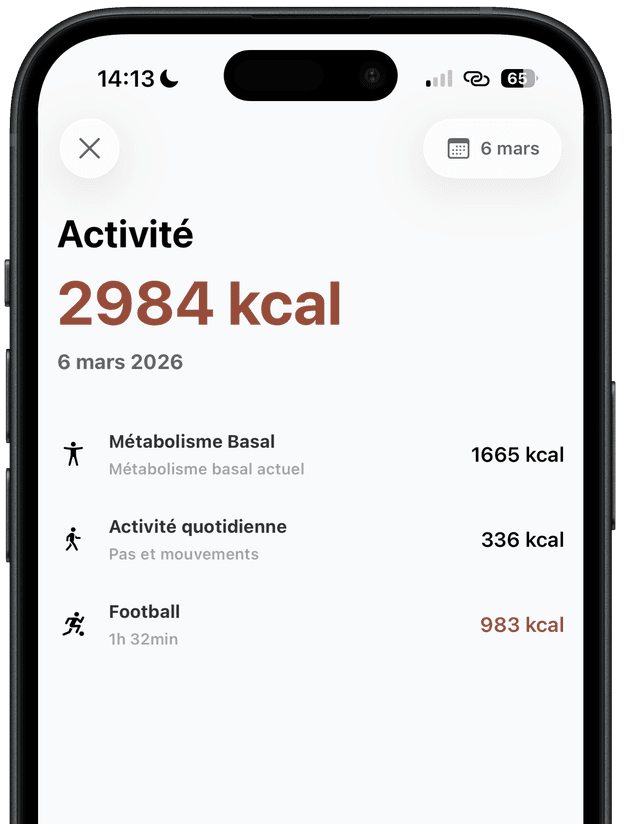
Ember helps you follow your activity and food habits over time without treating the treadmill calorie number as an exact measurement.
You might also like
View all articlesHow Many Calories Does Pilates Burn?
Calorie data by level and body weight, comparison with other activities, and tips to maximize expenditure.
How Many Calories Does Swimming Burn?
Calorie data by stroke, weight and intensity, comparison with running and cycling, tips to maximize burn.
Understanding macronutrients
Proteins, carbs, fats: learn the role of each macro and how to balance them for your goal.