HYROX: how many calories do you really burn?
Eight kilometres of running, eight stations and an energy cost that varies widely. Here is a clear way to estimate it.
 Fitness
Photo: Mathieu Improvisato / Unsplash
HYROX calories: useful reference points
The short answer
For a 70 kg (154 lb) person finishing in 90 minutes, assuming an average of 8 MET gives around 840 total kcal expended during the race. This is a worked example, not a HYROX measurement. Actual expenditure can differ substantially with pace, rest, technique and body weight.
The useful approach is to understand the calculation and put in your own time rather than rely on one universal figure.
How do you estimate calories burned?
A simple formula is kcal ≈ MET × body weight (kg) × duration (hours). MET expresses activity intensity relative to rest. The 2024 Compendium assigns 7.5 MET to self-paced jogging, 8.5 MET to running around 8 km/h and 9.3 MET around 10 km/h. It gives different values for rowing and conditioning exercises. It does not provide one measured MET for an entire HYROX race.
Using 8 MET for the whole race is therefore an illustrative assumption that also covers stations, transitions and slower sections. This formula estimates total calories. To approximate active calories, subtract about 1 MET × weight × time. In the 70 kg, 90-minute example: 8 × 70 × 1.5 = 840 total kcal, or roughly 735 active kcal.
Examples for a 90-minute race
At an assumed 8 MET average for 90 minutes:
These rows compare different weights at the same assumed duration and intensity. They do not predict any individual athlete’s result. A faster athlete may finish sooner but work harder; a longer race often includes more lower-intensity time.
Why the HYROX format matters
The official HYROX format alternates one kilometre of running with one functional station, eight times: 8 km of running and eight stations. Stations include the SkiErg, sled push and pull, burpee broad jumps, rowing, farmer’s carry, sandbag lunges and wall balls.
Running accounts for much of the work, but the sled and wall balls stress the muscles differently. Time in the transition zone and rest periods also lowers average intensity. Simply adding “8 km of running” to “eight strength sessions” can easily overstate the total.

Do the stations burn more than running?
There is no reliable calorie ranking for each HYROX station: load, speed, movement efficiency and time vary too much between participants. The SkiErg and rower may sustain a high cardiovascular effort; the sled and lunges also demand substantial muscular work.
For a better estimate, separate running time, station time and transitions when possible and use suitable intensity values. If all you know is your finish time, a broad range is more honest than a single-calorie total.

What changes the result?
The main variables are body weight, actual duration and average intensity. Training level, ergometer technique, division loads and breaks matter too. In Doubles, both partners run, but they share station work: do not automatically apply a Solo estimate to each person.
A longer finish time does not always mean more calories; the pace maintained throughout the race matters as well.
How should you read your watch estimate?
First compare like with like: total calories or active calories. A watch mainly estimates from your profile and heart rate. Gripping equipment, wrist movement, sweat and rapid changes in effort can make it inaccurate.
Use its number to compare your own races and workouts under similar conditions. Avoid treating it as an exact instruction for what to eat afterward: muscle recovery, hunger and your usual needs matter too.
Frequently asked questions
How many calories for a 90-minute HYROX? At 70 kg and a hypothetical average of 8 MET, around 840 total kcal. Your actual value may differ.
What about a 45-minute training session? At an assumed 7 MET average, 70 kg × 7 × 0.75 h = about 368 total kcal. A technical session with long breaks will use less.
HYROX or running: which burns more? At equal time and intensity, the estimated expenditure is similar. HYROX adds stations and transitions, so compare actual time and effort rather than activity names alone.
Keep in mind
Every number here is an educational estimate based on a MET formula, not a measurement taken during a HYROX race. Do not use it as a medical or dietary prescription. If you are new to intense exercise or have a health condition, seek guidance from a qualified professional.
Keep track of the bigger picture
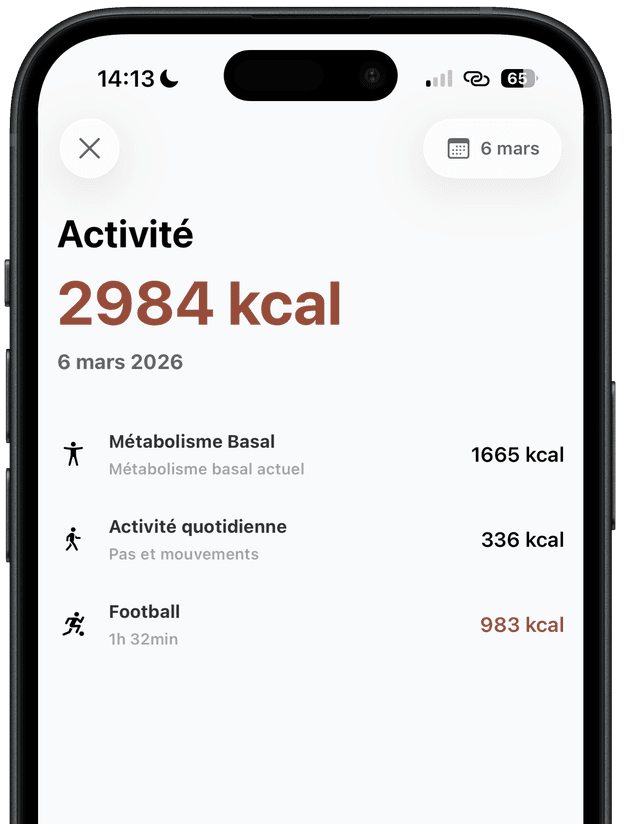
Ember helps you follow your habits and progress. A calorie estimate is a guide, not an exact measurement.
You might also like
View all articlesHow Many Calories Does Pilates Burn?
Calorie data by level and body weight, comparison with other activities, and tips to maximize expenditure.
How Many Calories Does Swimming Burn?
Calorie data by stroke, weight and intensity, comparison with running and cycling, tips to maximize burn.
Understanding macronutrients
Proteins, carbs, fats: learn the role of each macro and how to balance them for your goal.