Body Fat Percentage: The Number That Tells You More Than Your Weight
Two people can weigh exactly the same and have completely different bodies. Here's how to find out where you actually stand.
 Poids
PoidsBody Fat Percentage: The Complete Guide to Understanding and Improving It
The Number on the Scale Doesn't Tell the Whole Story
Two people can both weigh exactly 154 pounds and have completely different bodies. One might have well developed muscles and very little fat, the other a low muscle mass and more adipose tissue. Yet the scale gives the exact same verdict: 154 pounds.
That's the core problem with using weight alone as a health marker. It measures total mass without distinguishing what that mass is made of. Body fat percentage answers a more precise question: what proportion of your body is fat tissue, as opposed to muscle, bone, and water?
That distinction changes everything. It explains why some lean looking people actually carry excess body fat, and why others, heavier on the scale, are in excellent metabolic health thanks to a high muscle mass. Understanding your own body fat percentage gives you a far more accurate picture of your actual physical condition.
Body Fat vs BMI: Two Measurements, Two Different Stories
BMI remains the most widely used tool for assessing whether a weight is "normal". It's calculated by dividing weight by height squared, and sorts results into categories: underweight, normal weight, overweight, obese. The problem is that BMI can't tell the difference between a pound of muscle and a pound of fat.
A heavily muscled 220 pound rugby player and a sedentary person of the same weight can show the exact same BMI, even though their body composition has nothing in common. Body fat percentage fixes that blind spot by isolating exactly how much of your weight is fat, expressed as a percentage of total body weight.
That doesn't make BMI useless: it's still a decent screening tool at a population level, quick and free to calculate. But for precise individual tracking, especially for athletes or anyone going through a body recomposition, body fat percentage gives far more actionable information.
How to Measure Your Body Fat Percentage
Several methods can estimate body fat percentage, with very different levels of accuracy and cost. The most accessible is skinfold measurement with calipers: pinching the skin at several points on the body to estimate the thickness of subcutaneous fat. It's cheap, but accuracy depends heavily on the experience of whoever takes the measurement.
Bioelectrical impedance scales, increasingly common in households, send a faint electrical current through the body to estimate composition. Convenient and inexpensive, they still carry a margin of error of 3 to 5 percentage points, influenced by hydration, time of day, and even muscle mass, something worth remembering when comparing your numbers to those of someone doing regular strength training.
At the other end of the spectrum, DEXA scanning is considered the clinical gold standard: it precisely separates fat mass, muscle mass, and bone density. More expensive and less accessible, it's mostly used in research or advanced medical follow up. Finally, the "Navy method" only needs a tape measure and a few circumference measurements (neck, waist, hips) to get a reasonably accurate, free, and repeatable estimate, a solid option for tracking your own progress over time.

What Counts as a Healthy Body Fat Percentage?
Reference ranges differ noticeably between men and women, due to normal hormonal and physiological differences. For adult men, a body fat percentage between 10 and 20% is generally considered healthy, with athletes sometimes sitting between 6 and 13%. For women, the healthy range sits higher, between 18 and 28%, since the female body naturally needs a larger fat reserve to support hormonal and reproductive functions.
Age plays a role too: it's normal for body fat percentage to creep up slightly over the years, even at a stable weight, due to the gradual loss of muscle mass. Beyond these general benchmarks, where the fat sits matters just as much as how much there is. Excess fat accumulating around the abdomen, known as visceral fat, carries far higher cardiometabolic risks than the same amount of fat distributed around the hips or thighs.
A body fat percentage that's too low also carries risks: below essential thresholds (roughly 5% for men and 12% for women), the body no longer has the reserves needed for basic hormonal functions, which can disrupt the menstrual cycle, testosterone production, or immune function.
Lowering Body Fat Without Losing Your Sanity
Lowering your body fat percentage calls for a different approach than simply losing weight. The goal isn't to push the number on the scale down at any cost, but to lose fat while preserving, or even building, muscle mass. That starts with a moderate, sustainable caloric deficit: chasing rapid weight loss almost always triggers muscle loss, which makes body composition worse rather than better.
Intermittent fasting is a useful tool here, since it naturally makes it easier to maintain a caloric deficit without constant calorie counting. Paired with sufficient protein intake, it allows you to lose weight while limiting muscle loss, as long as you avoid swinging into excessive restriction.
Strength training rounds out this approach effectively: by stimulating muscle protein synthesis, it helps the body hold on to, or even grow, lean mass while losing fat. That combination, a moderate caloric deficit, enough protein, and regular strength work, is what actually improves your body fat percentage over time, rather than just making a number on a scale go down.

Key Takeaways
Body fat percentage gives a far more accurate picture of your physical condition than weight or even BMI, neither of which distinguishes muscle from fat. Bioelectrical impedance scales and skinfold calipers offer a practical at home estimate, while DEXA remains the clinical gold standard for precision. A healthy range generally falls between 10 and 20% for men and 18 and 28% for women, with where the fat sits mattering as much as how much there is. Lowering body fat sustainably relies on a moderate caloric deficit, enough protein, and regular strength training, not extreme restriction that sacrifices muscle along the way.
Disclaimer
The information in this article is for general educational purposes only. It does not replace personalized medical, dietary, or athletic advice. The body fat measurement methods mentioned here (bioelectrical impedance, skinfold calipers, DEXA, the Navy method) are estimates whose accuracy varies and should be interpreted with caution, ideally by tracking change over time rather than relying on a single reading. If you have an eating disorder, a chronic condition, or are considering a significant change to your diet or exercise routine, consult a healthcare professional before making any changes.
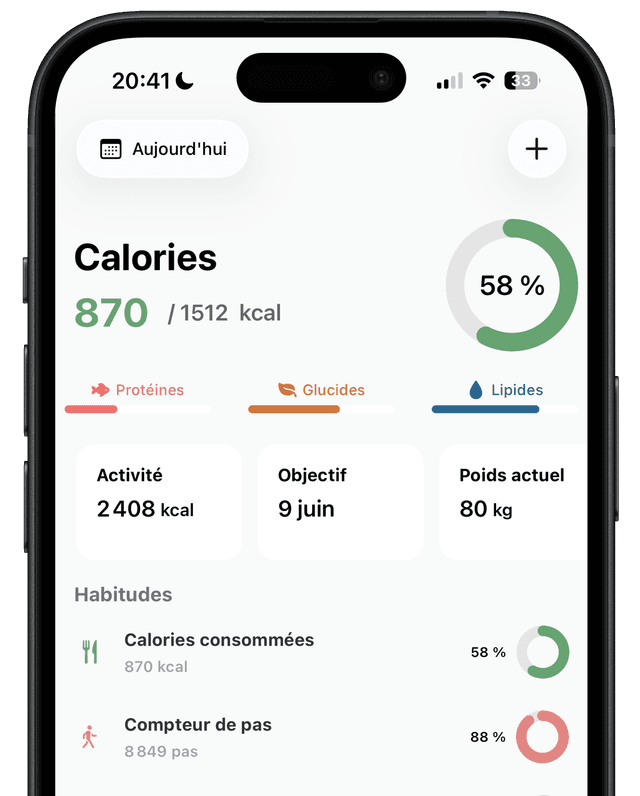
Track your body composition with Ember
Ember helps you track your weight and progress over time, so you can see beyond the number on the scale.
También te puede gustar
Ver todos los artículosDéficit calórico
Descubre cómo crear un déficit calórico saludable y sostenible para perder peso sin frustrarte.
Tasa metabólica basal: todo lo que necesitas saber para entender mejor tu peso
¿Qué es la tasa metabólica basal, cómo se calcula y qué se puede hacer para optimizarla?
Entendiendo los macronutrientes
Proteínas, carbohidratos, grasas: aprende el papel de cada macro y cómo equilibrarlos para tu objetivo.