Elliptical machine: how many calories do you really burn?
Often underestimated, the elliptical is one of the most complete cardio machines in the gym. Here is what the science says about its real calorie burn and its health benefits.
 Fitness
Everything you need to know about the elliptical machine
The elliptical: the cardio machine everyone underestimates
In almost every gym, the elliptical sits in a corner, often overlooked in favour of treadmills or stationary bikes. Yet those who have adopted it rarely go back. It combines the fluidity of cross-country skiing, the resistance of cycling, and the natural movements of brisk walking, all without the joint impact that makes running daunting for millions of people.
Its reputation as a "gentle machine" has unfairly given it an image of being an ineffective workout. The reality is quite different. At equivalent intensity, the elliptical burns as many calories as running, engages the whole body, and presents a much more favourable muscle fatigue profile that encourages consistency. And it is that consistency, precisely, that makes the difference when you are trying to manage your weight over the long term.
Understanding how the elliptical works, how many calories it really burns, and how to get the most out of it is a useful step, whether you are a beginner or a regular athlete.
How many calories does the elliptical actually burn?
The question comes up every time, and the answer is: it depends. The displays on gym machines often give generous estimates that can distort the perception of effort. Independent studies show that the elliptical burns between 400 and 600 kcal per hour for a person weighing 70 kg at moderate to sustained intensity. At low intensity, the figure is closer to 250 to 350 kcal per hour.
To give you a concrete benchmark: a 45-minute session at a good pace roughly corresponds to an expenditure of 350 to 450 kcal. That is not insignificant, especially when the session is practised regularly and integrated into a coherent nutritional strategy.
What is important to keep in mind is that the calorie burn displayed on the machine screen often overestimates reality by 10 to 20 %. Most machines are based on a standard weight of 70 to 80 kg and do not account for your actual fitness level. For reliable tracking, it is better to use a heart rate monitor or rely on personalised formulas.

What really determines your calorie expenditure
Two people side by side on identical ellipticals with the same settings will not burn the same calories. Several variables play a decisive role.
Body weight is the most important factor. The heavier you are, the more energy your body needs to move its mass. A person weighing 90 kg will burn approximately 30 to 40 % more than a person weighing 60 kg at the same intensity. This is a simple physical reality, often forgotten when comparing results with others.
Effort intensity is the second lever. Working with your arms as well as your legs, increasing resistance, or switching to high-intensity intervals multiplies the energy expenditure. A HIIT session on the elliptical, alternating 30 seconds of maximum effort with 90 seconds of active recovery, can burn as much in 20 minutes as a moderate continuous session lasting one hour.
Duration and consistency come next. Your basal metabolic rate evolves with training: a more muscular body burns more at rest, which amplifies the effect of each session over time.
The benefits that calories do not show
Reducing the elliptical to its calorie burn would be missing the point. It is one of the few cardio machines that simultaneously engages the lower body, the core, and the upper body, provided you actively use the handles rather than leaning on them. In a single session, you work the quadriceps, hamstrings, glutes, calves, pectorals, back muscles, and shoulders. This full-body engagement promotes high energy expenditure while limiting muscular imbalances.
The second advantage, often decisive for those with joint pain or returning from injury, is the absence of impact. Running generates an impact force that can reach two to three times body weight with each stride. The elliptical, by contrast, works with a continuous motion and no shock: ideal for the knees, hips, and lower back.
From a cardiovascular standpoint, 30 minutes on the elliptical practised three times a week is enough to improve VO2 max, a key indicator of cardiorespiratory capacity, and to reduce markers of metabolic syndrome. These are measurable health benefits, beyond aesthetics.

Elliptical, treadmill, bike: how do these activities compare?
Compared to the treadmill, the elliptical comes in almost equal on calorie burn for similar intensity and duration. The difference lies in impact and perceived effort: many people find the elliptical subjectively easier, which allows them to train longer without burning out. For someone looking to burn calories without getting injured or losing motivation, that is a significant advantage.
Compared to the stationary bike, the elliptical generally burns more calories because it engages the upper body as well as the legs. A moderate-effort indoor cyclist burns approximately 300 to 400 kcal per hour, compared to 400 to 600 for the elliptical. If your primary goal is calorie expenditure, the elliptical has the edge.
It remains, however, a pure cardio activity. If you want to build muscle mass to boost your long-term metabolism, a comparison with strength training versus cardio is worth exploring. The two approaches are not mutually exclusive: combining elliptical cardio and strength training is often the most effective strategy for transforming body composition.
How to maximise your results on the elliptical
Most people get on the elliptical, push at a moderate pace for 30 minutes, and wonder why they are not seeing results after a few weeks. The problem is not the machine: it is the monotony.
The first rule is to vary intensity. Steady-pace sessions eventually hit a plateau: the body adapts and burns less for the same effort. Incorporating interval sessions, even simple ones, restarts calorie burn and cardiovascular adaptation.
The second is to actually use your arms. Actively pushing and pulling the handles instead of leaning on them can increase expenditure by 15 to 25 %. It is a simple technical adjustment that transforms the quality of the session.
Finally, think about creating a slight caloric deficit if your goal is weight loss. The elliptical alone, without attention to what you eat, will not be enough to durably transform your body.
Elliptical and intermittent fasting: a combination worth knowing
More and more people practising intermittent fasting wonder whether they can train while fasted, and which machine to use. The elliptical is particularly well-suited to this use. Its low impact and the ability to modulate intensity precisely make it a safe option for fasted sessions.
Exercising in a fasted state increases the proportion of fat used as fuel, since glycogen stores are partially depleted after a night of fasting. At low intensity, the body draws more heavily on free fatty acids. The elliptical, used at moderate intensity in the morning before the first meal, fits perfectly with this metabolic profile.
To go further on the practice of exercising while fasted and what the science really says about its effects, you can consult our dedicated guide. The key point to remember is that intensity remains the decisive factor: a session that is too intense while fasted can be counterproductive if it causes excessive fatigue or muscle breakdown.
Key takeaways
The elliptical is one of the most complete and accessible cardio machines available. It burns between 400 and 600 kcal per hour depending on your profile and intensity, engages the whole body, and protects the joints, making it a lasting ally for weight management and physical condition. Results depend above all on consistency, intensity, and a diet adapted to your goals. Varying your sessions, actively using the handles, and pairing the elliptical with thoughtful nutrition are the three levers that truly make a difference.
Medical disclaimer: the information presented in this article is for educational purposes only. It does not replace medical advice or the guidance of a healthcare or fitness professional. If you have joint pain, a cardiac condition, or are returning from injury, consult a doctor before starting or intensifying a training programme.
Track your activity and calories with Ember
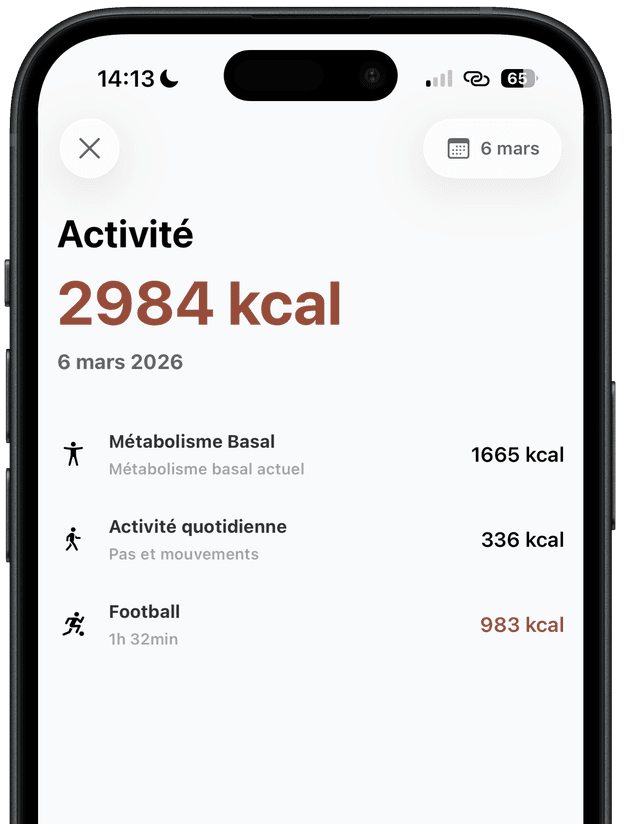
Ember helps you track your physical activity, understand your calorie expenditure, and reach your fitness goals, one session at a time.
You might also like
View all articlesHow Many Calories Does Pilates Burn?
Calorie data by level and body weight, comparison with other activities, and tips to maximize expenditure.
How Many Calories Does Swimming Burn?
Calorie data by stroke, weight and intensity, comparison with running and cycling, tips to maximize burn.
Understanding macronutrients
Proteins, carbs, fats: learn the role of each macro and how to balance them for your goal.