How Many Calories Does Swimming Burn?
Precise data by stroke, body weight and intensity, comparisons with running and cycling, and strategies to maximize your caloric expenditure.
 Fitness
The complete guide to calories burned while swimming
Swimming: a full-body cardio with zero joint impact
Swimming is one of the rare physical activities that simultaneously engages every major muscle group, upper limbs, lower limbs, core, and back, while virtually eliminating impact on the joints. In the water, 90% of body weight is supported by buoyancy, which drastically reduces the mechanical stress on the knees, hips, and spine compared to running or contact sports.
This characteristic makes swimming a uniquely versatile cardio tool: effective for overweight individuals, pregnant women, athletes in rehabilitation, and seniors alike. The American Heart Association (AHA) recommends 30 minutes of daily swimming as one of the most protective activities against coronary heart disease, with a risk reduction estimated at 30 to 40% among regular practitioners.
There is a fundamental difference between recreational swimming, relaxed, slow-paced, often discontinuous, and vigorous lap swimming performed with correct technique and sustained intensity. Caloric expenditure between these two modes can differ by a factor of two for the same session duration, which makes any calorie estimate entirely dependent on the actual intensity of practice.
How many calories does swimming actually burn?
The reference data comes from the Harvard Medical School, which publishes caloric estimates for 30 minutes of swimming based on body weight. In recreational swimming, a person weighing 57 kg burns approximately 180 kcal, a person of 70 kg burns approximately 216 kcal, and a person of 83 kg burns approximately 252 kcal per half-hour. In vigorous lap swimming, these figures rise to 300 kcal, 372 kcal, and 444 kcal respectively for the same weights.
For an hourly estimate based on the MET (Metabolic Equivalent of Task) from the ACSM Compendium, a 64 kg adult will burn approximately 223 kcal/h water walking (MET 3.5), 369 kcal/h swimming moderate crawl (MET 5.8), and 528 kcal/h swimming vigorous crawl (MET 8.3). These values assume continuous swimming without extended breaks.
The calculation formula used by exercise physiologists is: calories = MET × weight (kg) × duration (h). For a 75 kg adult swimming moderate crawl (MET 5.8) for 45 minutes: 5.8 × 75 × 0.75 = 326 kcal. This approach remains the most reliable method to personalize estimates to an individual profile.
Which swimming stroke burns the most calories?
The choice of stroke is the most decisive factor for caloric expenditure at equivalent intensity. According to ACSM Compendium MET values for a 64 kg adult, here is the ranking of strokes by hourly expenditure: water walking represents 3.5 METs or 223 kcal/h; backstroke reaches 4.8 METs or 305 kcal/h; breaststroke rises to 5.3 METs or 337 kcal/h; moderate freestyle reaches 5.8 METs or 369 kcal/h; vigorous freestyle climbs to 8.3 METs or 528 kcal/h; fast freestyle reaches 9.8 METs or 623 kcal/h; and butterfly peaks at 13.8 METs or 878 kcal/h.
Butterfly is by far the most energetically demanding stroke. It simultaneously engages the entire body: both arms exit the water fully on every arm cycle, while the dolphin kick, a continuous undulation of the hips and legs, keeps the abdominals, glutes, and hamstrings under constant tension. It is also the most technically difficult stroke to master, which limits its practice to experienced swimmers.
Breaststroke presents a particular profile: although it appears slower and more restful than freestyle, its MET of 5.3 is close to moderate crawl. This is explained by the strong activation of the pectorals, adductors, and calves during the propulsion phase, as well as the high frontal resistance created by the head position and the less streamlined body glide.

The factors that influence caloric expenditure
Three primary factors determine caloric expenditure in swimming. Body weight is the first: the heavier a person is, the more mass they displace through the water, which increases hydrodynamic resistance and therefore the muscular work required. A 90 kg person will burn approximately 30 to 40% more calories than a 60 kg person for the same stroke at the same speed. Swimming speed is the second factor: energy expenditure increases nearly linearly with speed, since water resistance increases with the square of speed, doubling speed quadruples resistance. Stroke choice is the third, as covered above, with butterfly demanding three times more energy than water walking.
Secondary factors are often underestimated. Water temperature plays a real role: in cold water (below 20 °C), the body activates thermogenesis to maintain core temperature, which increases total energy expenditure by 10 to 15% compared to swimming in temperate water. Environmental resistance also varies: swimming in the ocean or a lake with moderate current significantly increases effort. Resistance accessories used in training, short fins, hand paddles, a swimming parachute, or a drag suit worn over the swimsuit, can increase caloric expenditure by 15 to 25% depending on the accessory.
Swimming vs running vs cycling: caloric comparison
Swimming compares favorably with running when examining equivalent MET values. At a 10-minute-per-mile pace (approximately 6 min/km), jogging is estimated at 7 METs, a value nearly identical to vigorous freestyle (8.3 METs). Beyond that pace, vigorous swimming exceeds moderate running in caloric expenditure, while offering the decisive advantage of zero joint impact. For a 70 kg adult, 30 minutes of vigorous swimming burns 372 kcal, compared to approximately 300 kcal for 30 minutes of moderate jogging (8 km/h).
Against cycling, the comparison depends on intensity. Moderate cycling for 30 minutes burns approximately 260 kcal for a 70 kg adult, less than vigorous swimming (372 kcal). Intense cycling (road, hills) for 30 minutes reaches approximately 391 kcal, which is comparable to butterfly for the same duration (409 kcal for a 70 kg person). Swimming is therefore competitive with intense cycling, and significantly superior to moderate cycling.
The structural advantage of swimming lies in its physical versatility: at equivalent caloric expenditure, it engages the upper body far more than running or cycling, making it an ideal complement for cyclists and runners looking to strengthen their shoulder girdle, lats, and triceps without overloading the legs. For a low-impact complement to swimming, discover the benefits of Pilates.
Strategies to maximize caloric expenditure
The first strategy is to introduce artificial resistance into sessions. Hand paddles increase the propulsion surface and strengthen the shoulders, pectorals, and triceps while raising the energy cost of each lap by 10 to 15%. Short fins accelerate kick frequency and place greater demand on the quadriceps and calves. The drag suit, a resistance garment worn over the swimsuit, creates additional hydrodynamic resistance that can increase total session expenditure by 20 to 25%.
The second strategy is pool interval training, the aquatic equivalent of HIIT. The most effective protocol alternates 30-second sprints (maximum-speed freestyle) with 60 seconds of active recovery (slow backstroke or relaxed breaststroke), over a total of 20 to 30 minutes. This approach creates a significant EPOC effect, post-session caloric expenditure can reach an additional 50 to 100 kcal in the 2 hours following training, which is rare for steady-state swimming.
The third strategy is the individual medley: chaining butterfly → backstroke → breaststroke → freestyle on successive lengths. This rotation forces the body to recruit different muscle groups with each stroke change, prevents neuromuscular accommodation, and keeps heart rate elevated throughout the session. For an intermediate swimmer, 30 minutes of continuous medley can burn 420 to 480 kcal depending on body weight.

FAQs
Does swimming burn belly fat? Swimming burns fat systemically, not locally, like all cardio activities, it draws on the body's overall lipid reserves without preferentially targeting the abdomen. However, strokes that strongly engage the abdominals (butterfly, freestyle with trunk rotation) strengthen the underlying muscles, which improves abdominal definition as overall fat mass decreases through a global caloric deficit.
Which stroke burns the most calories? Butterfly, with a MET of 13.8 (878 kcal/h for a 64 kg adult), is by far the most energetically demanding stroke. However, it requires advanced technical mastery and is difficult to sustain over long durations. For intermediate swimmers, vigorous freestyle (8.3 METs, 528 kcal/h) or individual medley offer the best trade-off between high caloric expenditure and realistic session duration.
How long do you need to swim to burn 500 calories? For a 70 kg adult, it takes approximately 50 minutes of vigorous freestyle (MET 8.3), 60 minutes of breaststroke (MET 5.3), or 34 minutes of butterfly (MET 13.8) to reach 500 kcal. These durations assume continuous swimming without extended breaks. In low-intensity recreational swimming, over 90 minutes would be needed for the same result.
Cold water vs warm water swimming: what is the caloric difference? Swimming in cold water (15–20 °C) increases total energy expenditure by 10 to 15% compared to swimming in temperate water (26–28 °C), because the body activates thermogenesis to maintain core temperature around 37 °C. However, cold water can also reduce technical performance and session duration, which may offset this advantage. For most swimmers, water at 26–28 °C offers the best balance between performance and total caloric expenditure.
Disclaimer
The information presented in this guide is provided for educational and informational purposes only. It does not constitute personalized medical advice and is not a substitute for consultation with a qualified healthcare professional or certified fitness coach.
Consult a physician before starting or intensifying a swimming practice, particularly if you have a history of cardiovascular problems, asthma, ear or shoulder conditions, or are returning from injury. Swimming is generally considered safe for most adults, but certain strokes (notably butterfly) can place significant stress on the shoulders and lower back.
The calorie values cited in this guide are indicative averages drawn from data published by Harvard Medical School and the ACSM MET Compendium (American College of Sports Medicine). They vary depending on the individual, swimming technique, actual effort level, water temperature, and other individual physiological factors. Personalized calculations should be interpreted as approximations, not precise measurements.
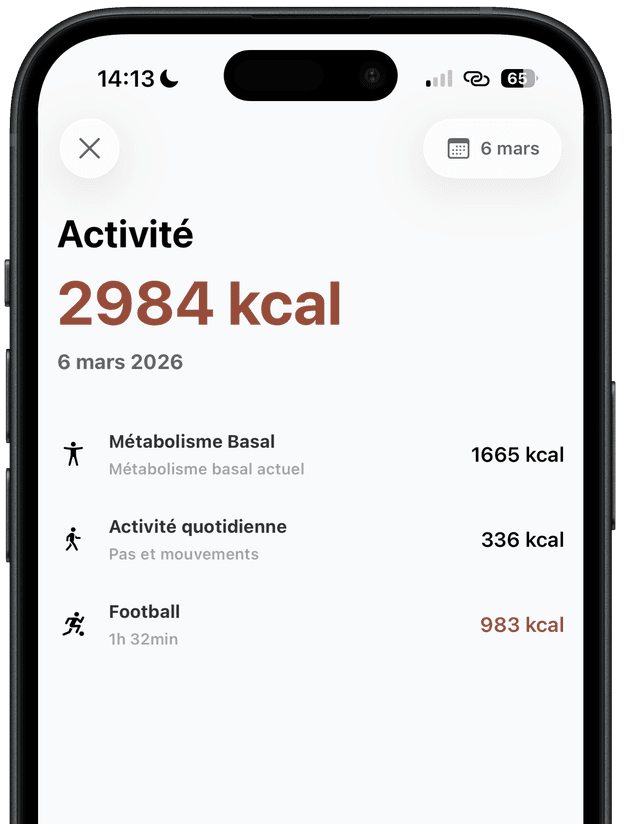
Track your swimming sessions with Ember
Log your physical activity and track your daily progress with Ember.
You might also like
View all articlesHow Many Calories Does Pilates Burn?
Calorie data by level and body weight, comparison with other activities, and tips to maximize expenditure.
How Many Calories Does Running Burn?
Calorie data by speed, weight and terrain, kcal/km formula, comparison with swimming and cycling, tips to maximize burn.
Understanding macronutrients
Proteins, carbs, fats: learn the role of each macro and how to balance them for your goal.