How Many Calories Does Running Burn?
Precise data by speed, body weight and terrain, kcal/km formula, comparisons with swimming and cycling, and strategies to maximize your caloric expenditure.
 Fitness
The complete guide to calories burned while running
Running: the world's most popular cardio activity
Running is the most widespread cardiovascular activity in the world, practiced by over 600 million people on every continent. Accessible without special equipment, it combines high caloric expenditure, intense cardiovascular demand, and maximum practicality, a proper pair of running shoes is all you need to start.
Unlike swimming or cycling, running generates repeated mechanical impact with every stride: on average, 3 times body weight is transmitted to the joints of the feet, ankles, knees, and hips. This mechanical stress, managed carefully through gradual progression and appropriate footwear, is also one reason for running's high caloric expenditure, the body must produce energy both to move forward and to absorb impact forces.
There is a significant difference between recreational jogging (around 8 km/h), sustained running (12 to 14 km/h), and interval training, short bursts at maximum effort interspersed with recovery. At moderate pace, running burns between 600 and 900 kcal/h depending on body weight and speed, placing it among the most effective activities for weight management.
How many calories does running actually burn?
The reference formula in exercise physiology is simple and robust: 1 kcal per kilogram of body weight per kilometer covered. For a 70 kg person who runs 10 km, the expenditure is approximately 700 kcal, regardless of speed, a remarkable property explained by the fact that the energy cost of locomotion is essentially tied to distance, not duration.
Data published by Harvard Medical School for 30 minutes of running allows further refinement based on body weight. In moderate jogging, a person weighing 57 kg burns approximately 240 kcal, a person of 70 kg approximately 288 kcal, and a person of 83 kg approximately 336 kcal per half-hour. In fast running (sustained pace), these figures rise to 360 kcal, 432 kcal, and 504 kcal respectively for the same weights.
Running has a notable metabolic characteristic: at equal distance, it burns approximately 40% more than walking. This difference is explained by the flight phase unique to running (both feet leave the ground simultaneously), by air resistance at higher speeds, and by the elastic rebound of tendons that requires additional energy production despite partial energy recovery.
Caloric expenditure by running speed
The MET (Metabolic Equivalent of Task) values from the ACSM Compendium establish a precise hierarchy of energy expenditure by pace. For a 64 kg adult, brisk walking at 6 km/h represents 4.0 METs or 254 kcal/h; jogging at 8 km/h reaches 7.0 METs or 446 kcal/h; running at 10 km/h climbs to 10.0 METs or 636 kcal/h; running at 12 km/h reaches 11.5 METs or 732 kcal/h; running at 14 km/h peaks at 13.5 METs or 859 kcal/h; trail running sits around 9.0 METs or 572 kcal/h; and intense hill or stair climbing can exceed 15.0 METs or 954 kcal/h.
The increase in expenditure with speed is nearly linear up to moderate paces, then accelerates at higher speeds due to air resistance and the growing cost of propulsion mechanisms. Moving from 8 km/h to 14 km/h does not simply double the speed, it almost doubles the hourly caloric expenditure, which explains why experienced runners burn significantly more than beginners over the same session duration.
The MET formula is: calories = MET × weight (kg) × duration (h). For a 75 kg adult running at 10 km/h for 45 minutes: 10.0 × 75 × 0.75 = 563 kcal. This approach remains the most reliable way to personalize estimates to an individual profile.

The factors that influence caloric expenditure
Three primary factors determine caloric expenditure in running. Body weight is the first and most direct: the formula 1 kcal/kg/km perfectly illustrates this linear relationship. A 90 kg person will burn 50% more calories than a 60 kg person over the same distance, regardless of speed. Running speed is the second factor: the relationship is nearly linear at moderate paces, but amplifies at high intensity. Running at 14 km/h burns almost twice as many calories per hour as jogging at 8 km/h. Terrain is the third factor, often underestimated: a 10% gradient increases energy expenditure by 50% compared to flat ground, and trail running in varied mountain terrain generates a 20 to 30% surcharge over flat road running due to variations in foot placement and constant trunk stabilization.
Secondary factors are equally real. Heat amplifies expenditure through thermogenesis: running at 30 °C increases total expenditure by 5 to 10% compared to 15 °C, since the body must simultaneously produce energy to run and activate its thermoregulation mechanisms (sweating, vasodilation). Training level plays a paradoxical role: an experienced runner with high VO2max is mechanically more economical at the same speed, and will burn slightly less than a beginner over the same distance, but will sustain a higher speed over time. Finally, footwear influences mechanics: minimalist low-drop shoes favor forefoot strike, which modifies muscular recruitment and can slightly increase expenditure over long distances. To better understand how your body burns calories at rest, check out our guide on basal metabolic rate.
Running vs swimming vs cycling: caloric comparison
Running compares favorably with other cardio sports on the criteria of calories per accessibility. At equivalent METs, jogging at 7 METs is close to vigorous freestyle swimming at 8.3 METs, with slightly lower expenditure, but running requires no pool, no special gear, and no complex technique to learn. For a 70 kg adult over 30 minutes, jogging burns 288 kcal, vigorous freestyle 372 kcal, and moderate cycling at 20 km/h 260 kcal.
Against cycling, running comes out ahead at moderate intensity. Cycling at 20 km/h represents approximately 7.5 METs, comparable to jogging, but demands far less ground reaction force, the cyclist's weight is supported by the saddle, reducing lower limb muscle recruitment and caloric expenditure at the same subjective effort level. Running requires fully supporting body weight at every stride, resulting in structurally higher expenditure for the same perceived effort.
Running offers the best ratio of calories burned to equipment investment and accessibility of all cardio activities. A budget running shoe is sufficient, no membership is required, and the activity can be practiced anywhere at any time, making it the most democratic weight management tool among high-intensity cardio sports. For a joint-friendly alternative, see our guide on swimming.
Strategies to maximize caloric expenditure
The first strategy is interval training (HIIT), the most effective method for amplifying total session caloric expenditure. A simple, validated protocol alternates 30-second maximum-effort sprints with 60 seconds of active recovery (slow jog), repeated 10 times over a total session of 15 to 20 minutes. This method creates a significant EPOC (Excess Post-exercise Oxygen Consumption) effect: metabolism remains elevated for 24 to 48 hours after the session, which can represent up to 150 additional kcal burned outside the session itself, a bonus that steady-state cardio does not generate at the same intensity.
The second strategy is to leverage trail running and hills. A 10% gradient increases expenditure by 50% compared to flat ground, while specifically strengthening the hamstrings, glutes, and calves, muscle groups often under-stimulated during road running. Incorporating a 200 to 400-meter uphill repeat section into a 45-minute session can increase total expenditure by 20 to 30% while also improving power output and fatigue resistance.
The third strategy is the [strength training + running](/guides/articles/musculation-vs-cardio) combination. Each additional kilogram of muscle mass increases resting metabolic rate by approximately 50 kcal per day. Over 3 months of a mixed program alternating 2 strength sessions and 3 running sessions per week, the average muscle gain is 1 to 2 kg, representing a bonus of 50 to 100 kcal/day in basal metabolic rate, or 4,500 to 9,000 additional kcal burned at rest over the quarter, independent of any running session.

FAQs
Does running burn more calories than walking at the same distance? Yes, by approximately 40%. Although the 1 kcal/kg/km formula is often presented as valid for both, the physiological reality is that running structurally burns more than walking at equal distance. The flight phase unique to running (no ground contact), higher aerodynamic resistance at faster speeds, and the energy cost of tendon rebound explain this surcharge. A 70 kg person burns approximately 490 kcal running 7 km, compared to roughly 350 kcal walking the same distance.
Do you need to run for 40 minutes before burning fat? No. The body constantly uses a mixture of carbohydrates and fats as fuel, even from the very first minutes of exercise. The proportion of fat does increase with effort duration, beyond 20 to 30 minutes at moderate pace, lipids represent more than 50% of the energy source, but the idea that you need to wait 40 minutes before burning fat is a myth. What matters for fat loss is the total caloric deficit over the day, not the energy substrate used during the session.
Treadmill vs outdoors: what is the caloric difference? A treadmill, in the absence of air resistance and terrain variation, slightly reduces caloric expenditure compared to outdoor running at the same displayed speed. To compensate, experts recommend setting the treadmill to a minimum 1% incline, which simulates air resistance and makes expenditure comparable. In practice, the difference is 5 to 8% at moderate pace.
How many kilometers to run to burn 500 kcal? For a 70 kg person, approximately 7 km is needed (applying the 1 kcal/kg/km formula: 70 × 7.1 ≈ 497 kcal). For a 60 kg person, approximately 8.3 km will be required. These estimates are based on the 1 kcal/kg/km formula and assume continuous running at a moderate pace.
Disclaimer
The information presented in this guide is provided for educational and informational purposes only. It does not constitute personalized medical advice and is not a substitute for consultation with a qualified healthcare professional or certified fitness coach.
Consult a physician before starting or intensifying a running practice, particularly if you have a history of cardiovascular problems, joint issues (knees, hips, ankles), or tendinopathy. Running is a moderate-to-high impact activity, progressing too rapidly is one of the leading causes of overuse injuries (iliotibial band syndrome, shin splints, stress fractures).
The calorie values cited in this guide are indicative averages drawn from data published by Harvard Medical School and the ACSM MET Compendium (American College of Sports Medicine), as well as reference data from campus.coach. They vary depending on the individual, running technique, actual pace, terrain, temperature, and other individual physiological factors. Personalized calculations should be interpreted as approximations, not precise measurements.
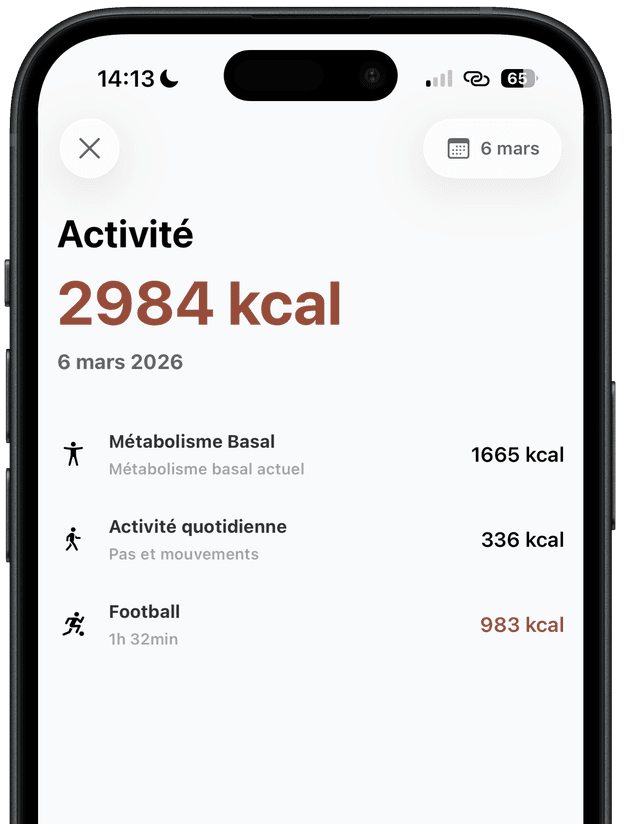
Track your running sessions with Ember
Log your physical activity and track your daily progress with Ember.
You might also like
View all articlesHow Many Calories Does Pilates Burn?
Calorie data by level and body weight, comparison with other activities, and tips to maximize expenditure.
How Many Calories Does Swimming Burn?
Calorie data by stroke, weight and intensity, comparison with running and cycling, tips to maximize burn.
Understanding macronutrients
Proteins, carbs, fats: learn the role of each macro and how to balance them for your goal.