BMI: a reliable indicator or misleading for assessing your health?
Calculation formula, WHO chart, limitations for athletes, and concrete alternatives to better understand what your body is really telling you.
 Santé
SantéBMI explained: from theory to reality
What is BMI?
The Body Mass Index (BMI) is a measurement tool that estimates a person's body composition by relating their weight to their height. Expressed in kg/m², it places an individual in a body weight category defined by the World Health Organization.
Since 1997, the WHO has used it as a global reference for assessing health risks associated with overweight and obesity in adults. Today it is one of the most widely used indicators in preventive medicine — not because it is perfect, but because it is simple, quick, and free.
Understanding what it actually measures — and what it does not — is essential to using it correctly.
Origin and history of BMI
BMI is not a recent invention. It was developed in 1832 by Belgian mathematician and statistician Adolphe Quetelet, who was seeking to define the characteristics of the "average man" for statistical purposes — not medical ones.
For over a century, this index remained in the field of demographic research. It was in the 1970s that American epidemiologist Ancel Keys gave it its current name and demonstrated its correlation with body fat at a population level.
In 1997, the WHO officially adopted BMI as the reference tool for monitoring overweight and obesity worldwide. Since then it has become indispensable in medical follow-up, even though the scientific community continues to debate its limitations.
How to calculate your BMI?
The formula is simple: BMI = Weight (kg) ÷ Height² (m)
Practical example: a person weighing 60 kg and standing 1.70 m tall gets:
60 ÷ (1.70 × 1.70) = 60 ÷ 2.89 = 20.76 kg/m²
This result falls within the normal body weight range according to WHO criteria.
A few practical tips:
BMI categories according to the WHO
The WHO defines six body weight categories based on BMI:
Within the "normal" range, the values statistically associated with the best health outcomes are 22.4 kg/m² for women and 22.7 kg/m² for men.
These thresholds are population-level benchmarks, not individual diagnoses. A BMI outside the normal range does not automatically indicate a health problem, and a normal BMI does not guarantee the absence of risks.
Why BMI misleads athletes
One of the best-known limitations of BMI is its inability to distinguish muscle mass from fat mass.
One kilogram of muscle is much denser than one kilogram of fat. A very muscular athlete may therefore display a BMI in the "overweight" zone even though their body fat percentage is low and their physical condition is excellent. Conversely, a sedentary person with a normal BMI may have undetected visceral fat excess.
This phenomenon has a name: normal weight obesity (or "skinny fat"). It affects people whose BMI is within range but whose body composition is unfavorable: little muscle, too much fat.
Conclusion: for physically active individuals, BMI alone is an insufficient and potentially misleading indicator.
Other limitations of BMI
Beyond the case of athletes, BMI suffers from several important shortcomings.
It ignores fat distribution. The location of fat in the body is a major cardiovascular risk factor. Abdominal (visceral) fat is far more dangerous than subcutaneous fat around the hips and thighs. Two people with identical BMIs can have very different risk profiles depending on their morphology.
It does not account for age. With age, muscle mass naturally decreases and fat mass increases, even without weight change. BMI does not reflect these age-related changes in body composition.
It ignores ethnic differences. Several studies show that metabolic risks appear at different BMI thresholds depending on ethnic origin. Southeast Asian populations face higher risks from a BMI of 23, while the standard WHO threshold is set at 25.
It does not take into account medical history, lifestyle, or physical activity level. Two people with the same BMI can have radically different states of health.
Alternatives to BMI
To get a more complete picture of your health, several complementary tools exist.
Bioelectrical impedance analysis (BIA) measures body composition using electrical bioimpedance. It distinguishes fat mass, muscle mass, bone mass, and hydration level. It is a valuable tool for tracking the effects of a sports or nutrition program on body composition, independent of weight.
Waist circumference is a simple and effective indicator of cardiovascular and metabolic risk. Warning thresholds are: > 80 cm for women and > 94 cm for men. Beyond 88 cm (women) and 102 cm (men), the risk is considered high.
Blood tests remain the medical gold standard. They assess cholesterol (HDL/LDL), fasting blood sugar, triglycerides, and other markers directly linked to cardiovascular and metabolic risks.
A medical consultation integrates all of this data with your medical history, lifestyle, and physical activity for a comprehensive and personalized assessment.
The concept of ideal body weight
Beyond numbers and charts, there is a more personal concept: your ideal body weight. This is the weight at which a person feels physically and mentally well — with energy, without frustration and without constant restriction.
This weight is not necessarily the same for two people with the same "ideal" BMI. It depends on your personal history, your morphology, your lifestyle habits, and your goals.
The healthiest approach is to aim for a sustainable balance — a varied diet, regular physical activity, quality sleep — rather than optimizing a number on a scale or a mathematical formula.
BMI can be a useful starting point for an initial assessment, but it should never be the sole criterion for judging your health status or body image.
Medical disclaimer
The information in this article is provided for educational and informational purposes only. It does not constitute personalized medical advice and does not replace consultation with a qualified healthcare professional.
BMI is a statistical index, not a diagnosis. Any decision regarding your weight, diet, or physical activity should be made in consultation with a doctor or dietitian, especially if you have an existing medical condition.
This information is based on recommendations from the WHO and national health authorities.
Track your health with Ember
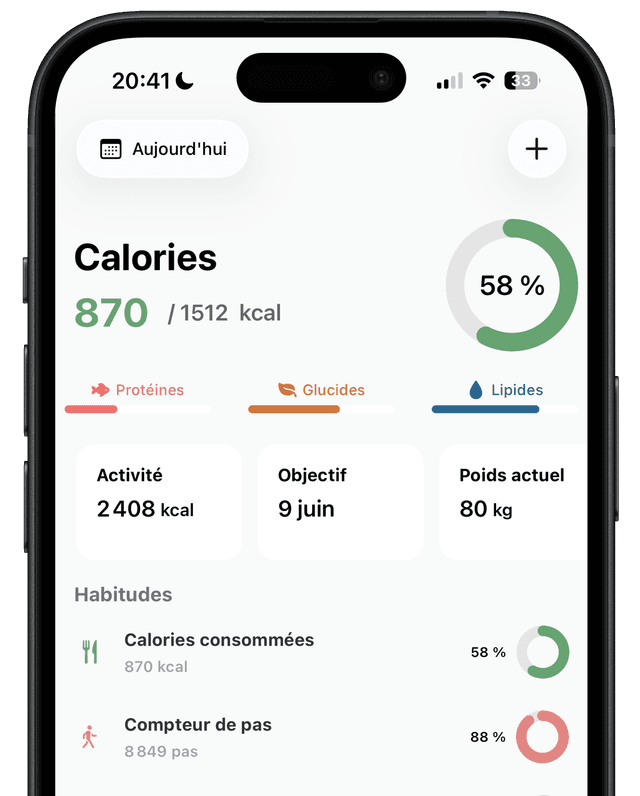
Ember helps you track your weight, nutrition, and fasting periods to sustainably reach your ideal body weight.
You might also like
View all articlesWater retention: understand and act
Causes, symptoms and practical solutions to reduce water retention and restore lightness and well-being.
Hydration: how much water should you drink per day?
Daily water needs, signs of dehydration, hydrating foods and practical tips to stay well-hydrated throughout the day.
Understanding macronutrients
Proteins, carbs, fats: learn the role of each macro and how to balance them for your goal.